

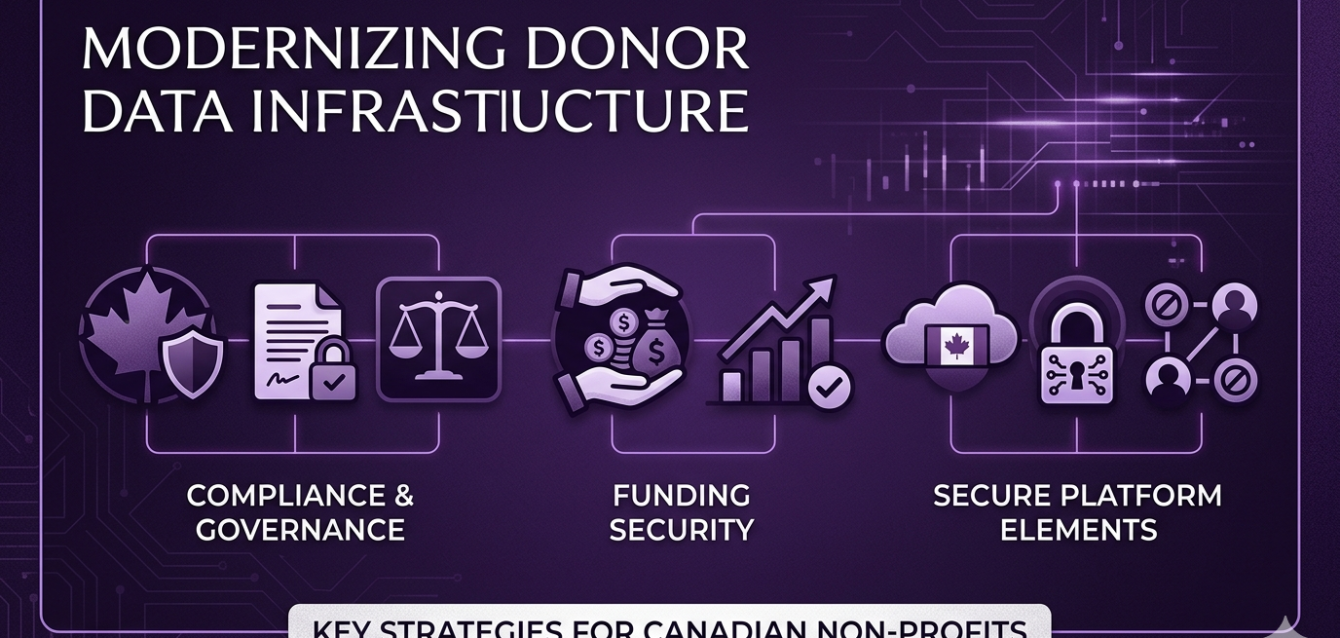
Why Canadian Non-Profits Are Rethinking Their Donor Data Infrastructure
The CRM you use to manage your donors may be your biggest compliance risk. Currently, Canadian non-profits and INGOs are not usually the organizations that come to mind when regulators discuss data security. However, that assumption is becoming increasingly expensive.
Over the past three years, many Canadian charities have faced intense data infrastructure scrutiny. Specifically, organizations receiving federal or provincial government funding must now prove their security as a condition of grant renewal. Institutional donors and foundations are asking questions about data governance. Most standard CRM platforms cannot answer these questions. Consequently, your data infrastructure is a governance risk—and a strategic one.
To remain competitive for funding, your stack must evolve to meet modern non-profit donor data security Canada standards.
What Canadian Privacy Law Actually Requires of Non-Profits
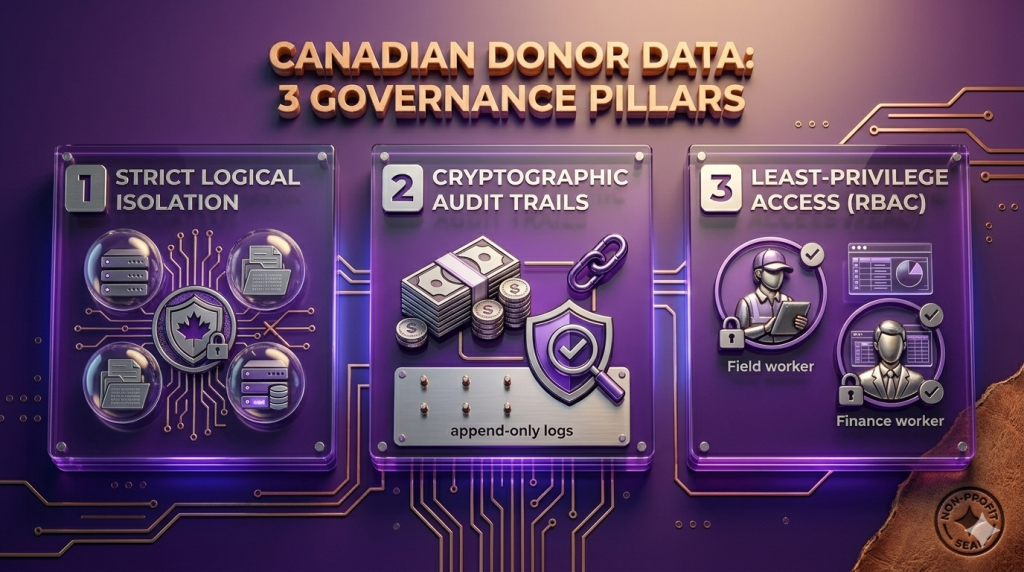
PIPEDA applies to commercial activities. Therefore, many non-profits initially assume they are exempt. This assumption is wrong for two critical reasons.
1. The “Commercial Activity” Trap
Many non-profit activities qualify as commercial under PIPEDA. This includes fundraising campaigns, branded e-commerce, and fee-for-service programs. Any personal data collected for these activities is fully covered. If you collect $10$ dollars for a t-shirt or a ticket, the data surrounding that transaction must meet PIPEDA non-profit compliance rules.
2. Provincial Legislation
Provincial laws in Quebec (Law 25) and British Columbia (PIPA) apply to non-profits explicitly. They do not care if an activity is commercial or not. Non-profits in Quebec are now subject to the strongest governance requirements in Canada. You must implement data minimization, maintain processing registers, and appoint a Privacy Officer. Furthermore, under Bill C-26, breach notification requirements will become more stringent for everyone.
The Government Funding Problem
Federal and provincial granting bodies are raising the bar. Organizations like Canadian Heritage, IRCC, and ESDC now view responsible data governance as a prerequisite for public funds.
Granting bodies are looking for specific technical evidence. They want to see that your charity data infrastructure Canada provides:
- Sovereignty: Proof that data is stored on Canadian servers.
- Traceability: Access-controlled environments with detailed audit logging.
- Lifecycle Management: Documented data retention and automated deletion policies.
- Isolation: Protection against cross-tenant data leakage if using shared infrastructure.
If you cannot provide this evidence, you will face friction during grant renewals. Consequently, a weak CRM can lead directly to a loss of funding.
The Specific Risks of Standard Non-Profit CRM Platforms
Most non-profit CRM platforms—like Salesforce, Blackbaud, or HubSpot—were built for flexibility. They were not designed for the specific constraints of Canadian regulated non-profits.
Data Residency and Sovereignty
Standard CRM platforms often store data on US servers by default. Canadian privacy law and certain government funders often prohibit this. Even if you can toggle a “Canada” region, your metadata might still leak across borders.
Multi-Tenant Isolation Gaps
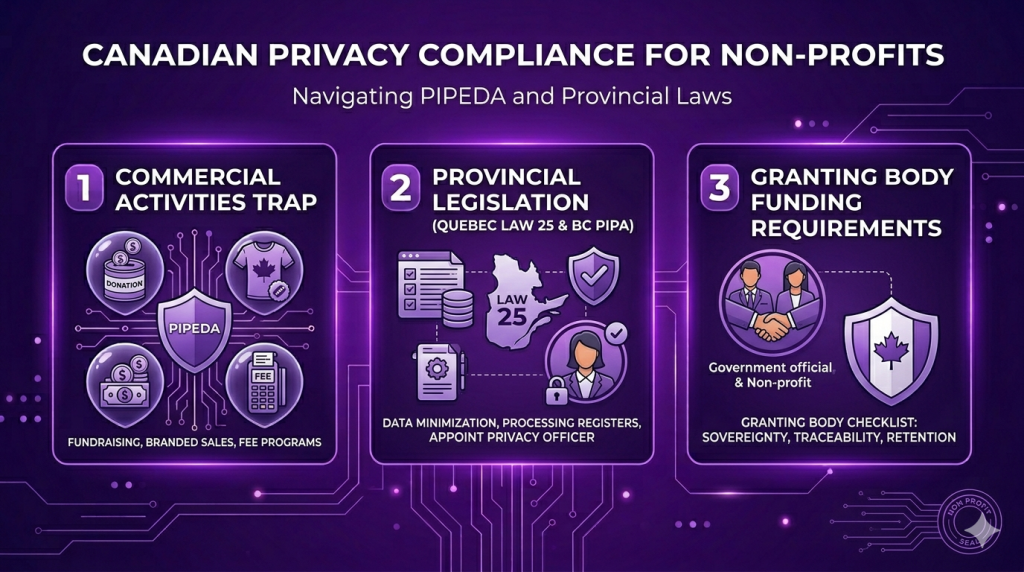
Do you use a shared CRM instance across multiple programs? If so, you are at risk. Standard platforms often fail to provide the level of data isolation required. Ideally, Program A’s data should be invisible to Program B’s staff. Without strict isolation, a breach in one department compromises the entire organization.
The Problem with Mutable Logs
Standard platforms log user actions. However, these logs are typically not immutable. A system administrator can often modify or delete them. For organizations subject to government grant auditing, this is a structural gap. You need an “append-only” log that proves who accessed what, and when. For a deeper look at how to build these secure layers, see our guide on Zero-Trust SaaS for Canadian Regulated Businesses: The Complete Strategy.
What a Proper Donor Data Infrastructure Looks Like
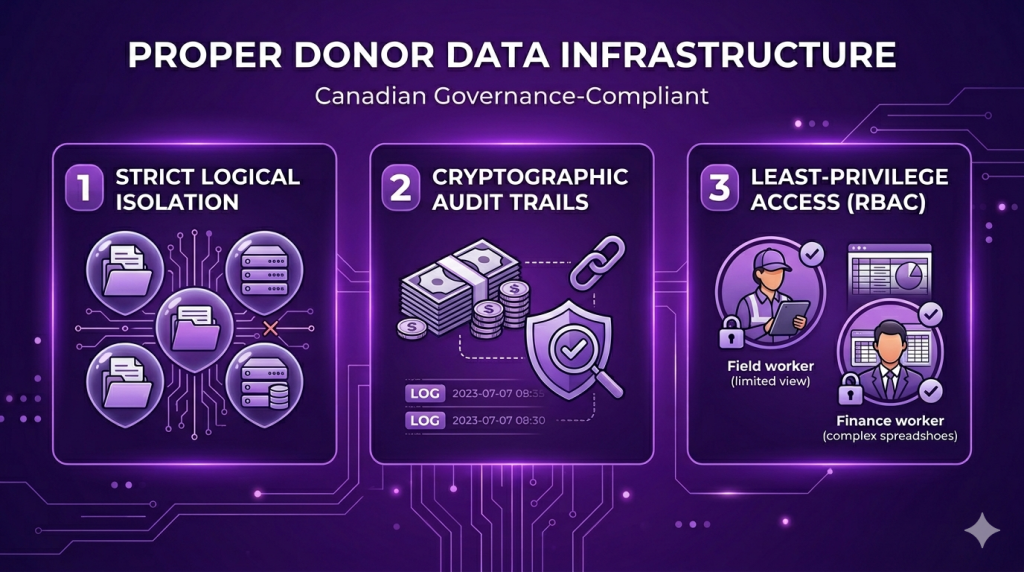
A platform built for Canadian governance requirements implements three core pillars.
1. Strict Logical Isolation
Each program or funder relationship should run in an isolated data environment. Cross-program data sharing must be explicit and logged. It should require deliberate configuration, not just a shared login. This prevents “lateral movement” during a security incident.
2. Cryptographic Audit Trails
In the non-profit world, you must follow the money. Every grant payment and expense allocation should be recorded with a tamper-proof audit trail. This ensures that when a funder asks for a report, you can provide an immutable history of every dollar spent.
3. Least-Privilege Access (RBAC)
Field workers do not need to see donor financial data. Finance teams do not need to see beneficiary health notes. A compliant system uses Role-Based Access Control (RBAC) to ensure staff have access only to what is required for their specific function. This minimizes the “blast radius” of a compromised account.
The Strategic Advantage of Custom Infrastructure
Custom SaaS development was once considered too expensive for non-profits. However, the calculation is changing for two reasons.
- Total Cost of Ownership: The cost of standard CRM licensing and compliance “workarounds” adds up. Over $5 years, a purpose-built solution often becomes more cost-effective.
- Competitive Edge: Organizations with strong data governance are more competitive. Foundations prefer to give money to organizations that can prove their data is safe. Your platform becomes a strategic asset for your fundraising team.
Is Your Infrastructure Ready for Your Next Audit?
Building for compliance is a journey. Don’t wait for a grant renewal to find the holes in your architecture. Architectural shortcuts taken today will lead to regulatory hurdles that could halt your mission.
At Espace Info Tech, we help Canadian non-profits navigate PIPEDA and provincial privacy laws. We build the secure, scalable foundations you need to satisfy both donors and regulators.
Contact Espace InfoTech for a donor data governance assessment today. We help you build secure, audit-ready platforms for the Canadian non-profit sector.