Building a modern application is only part of the challenge. Businesses also need to release updates quickly, maintain security, manage infrastructure, and keep applications reliable as users and workloads grow. This is where a cloud DevOps strategy can make a significant difference.
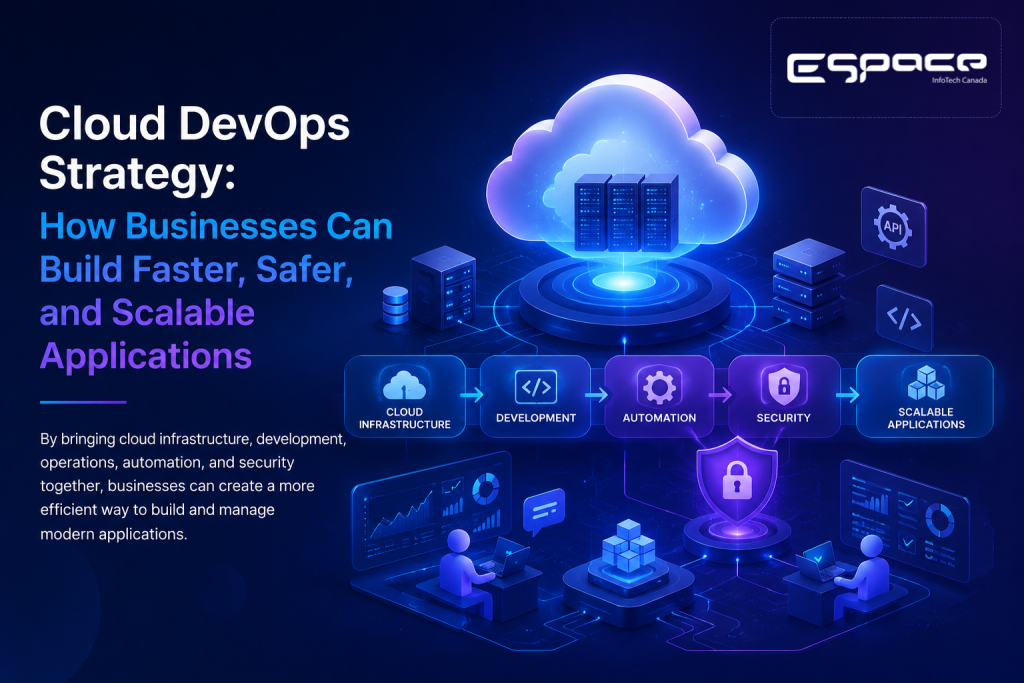
By combining cloud infrastructure, development, operations, automation, security, and continuous delivery, businesses can create a more efficient way to build and manage applications.
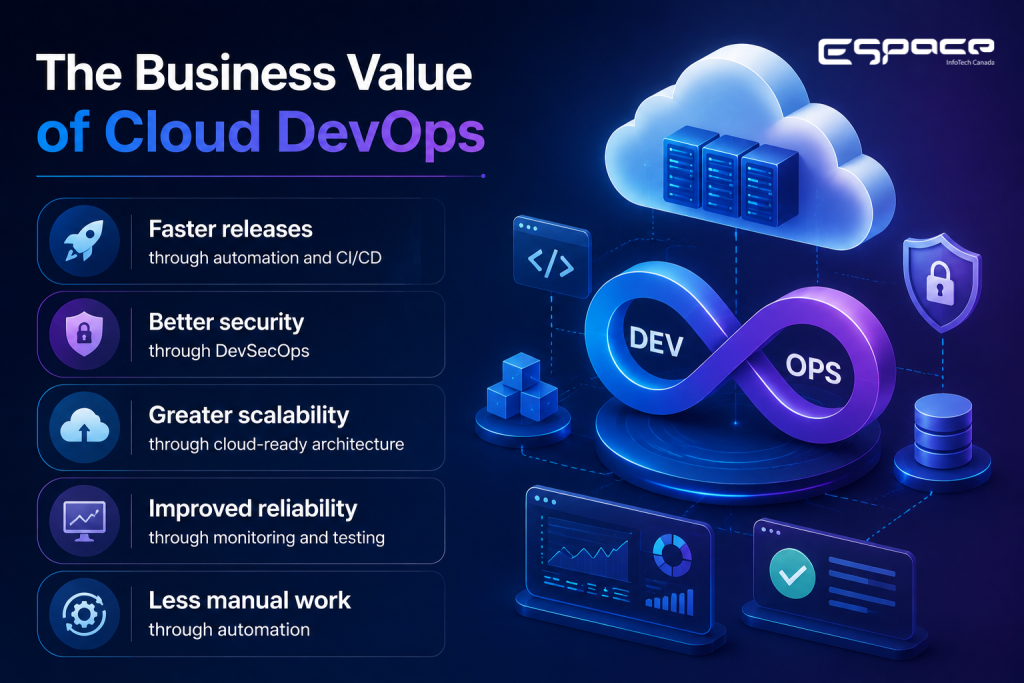
Instead of treating development and operations as separate processes, DevOps brings teams and workflows together. Cloud technology adds the flexibility to provision resources, deploy applications, and scale infrastructure as business requirements change. The result can be faster releases, more reliable applications, stronger security practices, and easier scalability.
What Is a Cloud DevOps Strategy?
A cloud DevOps strategy is an approach to software development and operations that uses cloud infrastructure, automation, collaboration, monitoring, and continuous delivery to improve the application lifecycle.
A typical strategy may include:
Cloud infrastructure management
Continuous integration and delivery
Infrastructure as Code
Automated testing
Deployment automation
Security integration
Application monitoring
Performance management
Backup and recovery
The objective is not simply to move an application to the cloud. It is to create a development and deployment process that is repeatable, secure, and scalable.
Why Businesses Need Cloud DevOps
Traditional development and deployment processes often involve manual testing, infrastructure configuration, release approvals, and server management. As applications grow, these processes can become slow and difficult to maintain.
Businesses may experience:
Longer release cycles
Deployment errors
Inconsistent environments
Manual infrastructure work
Security gaps
Difficulty scaling applications
Limited visibility into application performance
A cloud DevOps strategy can automate many of these activities and create a more consistent development workflow.
1. Automate the CI/CD Pipeline
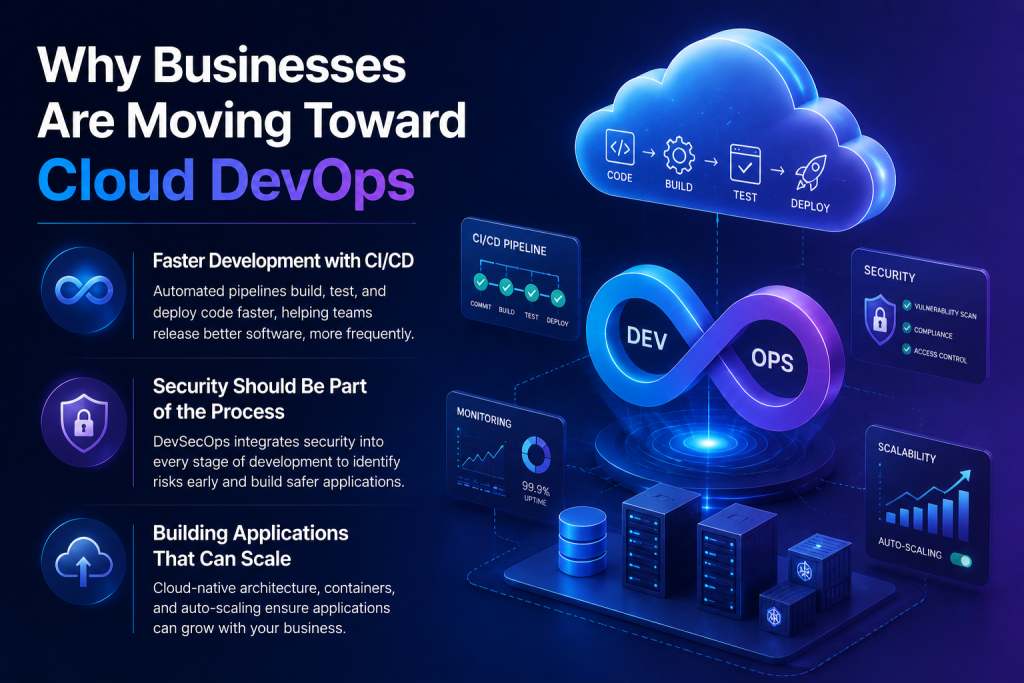
Continuous Integration and Continuous Delivery are central to modern DevOps. A CI/CD pipeline can automatically build, test, and prepare application changes for deployment. Instead of manually moving code between environments, developers can commit changes and allow automated processes to perform testing and deployment steps.
This can help businesses:
Release updates faster
Detect problems earlier
Reduce deployment errors
Create repeatable releases
Improve developer productivity
The exact pipeline should be designed around the application’s architecture, team structure, and business requirements.
2. Use Infrastructure as Code
Cloud infrastructure can become complicated when resources are configured manually. Infrastructure as Code (IaC) allows teams to define infrastructure through configuration files and manage it using version-controlled processes. This makes environments more consistent and easier to reproduce.
For example, development, testing, and production environments can follow the same infrastructure definitions while using different configurations. IaC can also make infrastructure changes easier to review, track, and roll back.
3. Integrate Security into DevOps
Security should not be left until the final stage of development. A stronger approach is to integrate security throughout the development lifecycle. This is often referred to as DevSecOps.
Security practices can include:
Automated vulnerability scanning
Dependency checking
Secure coding practices
Secrets management
Access control
Container security
Infrastructure security checks
Security monitoring
By identifying security issues earlier, businesses can reduce the cost and disruption of fixing them later.
4. Build for Scalability
One of the biggest advantages of cloud infrastructure is the ability to scale resources as application demand changes. However, simply using cloud infrastructure does not automatically make an application scalable. Applications should be designed with scalability in mind.
Depending on the workload, this may involve:
Load balancing
Containerization
Auto-scaling
Caching
Database optimization
Queue-based processing
Distributed architecture
A good cloud DevOps strategy connects application architecture with infrastructure planning.
5. Automate Testing
Testing is another area where automation can improve development speed. Automated tests can run whenever developers submit new code. Depending on the application, teams may use unit testing, integration testing, API testing, security testing, and end-to-end testing.
Automated testing helps identify problems before changes reach production. This creates more confidence in frequent releases while reducing dependency on repetitive manual testing.
6. Monitor Applications in Real Time
Deployment is not the end of the DevOps process. Businesses need to know how their applications perform after release.
Monitoring can track:
Application errors
Response times
Infrastructure usage
Database performance
Resource consumption
Availability
Security events
Logs, metrics, and alerts help teams identify problems before they significantly affect users. Good monitoring also provides data that can be used to improve application performance over time.
7. Improve Collaboration Between Teams
DevOps is not only about tools. It also changes how development, operations, security, and business teams work together.
Shared workflows, version control, automated pipelines, documentation, monitoring dashboards, and clear responsibilities can reduce communication gaps. When teams share ownership of application delivery and reliability, problems can often be resolved faster.
AI Implementation in Cloud DevOps
AI is becoming another useful layer in DevOps when applied to practical problems. AI can analyze logs, identify unusual system behaviour, summarize incidents, predict potential performance issues, and help teams investigate deployment failures.
For example, an AI-assisted monitoring system could analyze large volumes of application logs and highlight patterns that may indicate a developing problem. AI can also support developers by generating deployment summaries, explaining errors, suggesting possible causes, or helping create infrastructure configurations that engineers can review. However, AI-generated changes should not automatically be trusted in production. Human review, security controls, testing, and approval workflows should remain part of the process.
How to Build a Practical Cloud DevOps Strategy
Businesses do not need to automate everything on day one. A practical approach starts by reviewing the current development and deployment process. Identify where teams spend the most time. Look for manual deployments, repeated testing tasks, infrastructure inconsistencies, security gaps, and monitoring limitations.
Then prioritize automation based on business impact.
A typical roadmap may include:
Assess the existing development workflow
Define cloud and infrastructure requirements
Build a CI/CD pipeline
Introduce Infrastructure as Code
Automate testing
Integrate security checks
Implement monitoring and alerting
Add AI-assisted DevOps capabilities where useful
Continuously review and improve the process
This approach helps businesses improve gradually without disrupting existing operations.
Conclusion
A strong cloud DevOps strategy is about more than deploying applications to the cloud. It is about creating a repeatable way to develop, test, secure, deploy, monitor, and scale software.
Automation can reduce repetitive work.
CI/CD can accelerate releases.
DevSecOps can bring security earlier into development.
Cloud infrastructure can support changing workloads.
AI can provide additional operational insights.
When these practices work together, businesses can build applications that are faster to release, easier to maintain, and better prepared for growth.
Espace InfoTech Canada Inc. can help businesses develop cloud-ready applications and implement DevOps strategies with automation, CI/CD, security, monitoring, and scalable infrastructure.
FAQ
What is a cloud DevOps strategy?
A cloud DevOps strategy combines cloud infrastructure, development, operations, automation, security, continuous delivery, and monitoring to improve the software lifecycle.
How does DevOps help businesses release applications faster?
DevOps automates processes such as building, testing, and deployment, reducing manual work and making releases more consistent.
What is CI/CD in DevOps?
CI/CD stands for Continuous Integration and Continuous Delivery. It enables teams to automatically build, test, and prepare software changes for deployment.
What is DevSecOps?
DevSecOps integrates security practices into the development and DevOps lifecycle instead of treating security as a final-stage activity.
Can AI be used in cloud DevOps?
Yes. AI can help analyze logs, identify unusual behaviour, summarize incidents, investigate failures, and support performance monitoring.
Does moving to the cloud automatically make an application scalable?
No. Cloud infrastructure provides scalability options, but the application architecture, database, infrastructure, and deployment processes must be designed to use those capabilities effectively.