

AI-Powered Real Estate Website Design: Smart Features and Emerging Trends for 2027
A real estate website used to have a fairly simple job: display properties, provide contact information, and give visitors a way to get in touch.
That is no longer enough for many property businesses.
Buyers and sellers expect faster search, useful recommendations, mobile-friendly experiences, clear property information, and quick answers. Agents also need websites that connect with CRM systems, listing data, lead management, analytics, and marketing workflows.
This is where AI-powered real estate website design becomes interesting.
AI does not need to replace the real estate professional. It can make the website better at helping users find relevant properties, answer common questions, qualify leads, and move visitors toward the right next step.
The trends discussed below are not predictions presented as facts. They are 2027 trends to watch, based on technology and real estate developments already visible in 2026.
Why Is AI Becoming Part of Real Estate Website Design?
AI is moving from experimental technology toward practical business use.
The Canadian Real Estate Association has highlighted AI use for tasks such as managing emails, transcribing notes, scheduling appointments, organizing documents, following up with clients, and analyzing data. CREA also emphasizes that AI should support—not replace—professional judgment and client relationships.
For a website, this creates an opportunity to move beyond static pages.
Instead of simply showing a visitor hundreds of properties, an AI-enabled website can help them narrow down options, understand listings, ask questions, and connect with an agent.
What Are the Emerging Real Estate Website Design Trends for 2027?
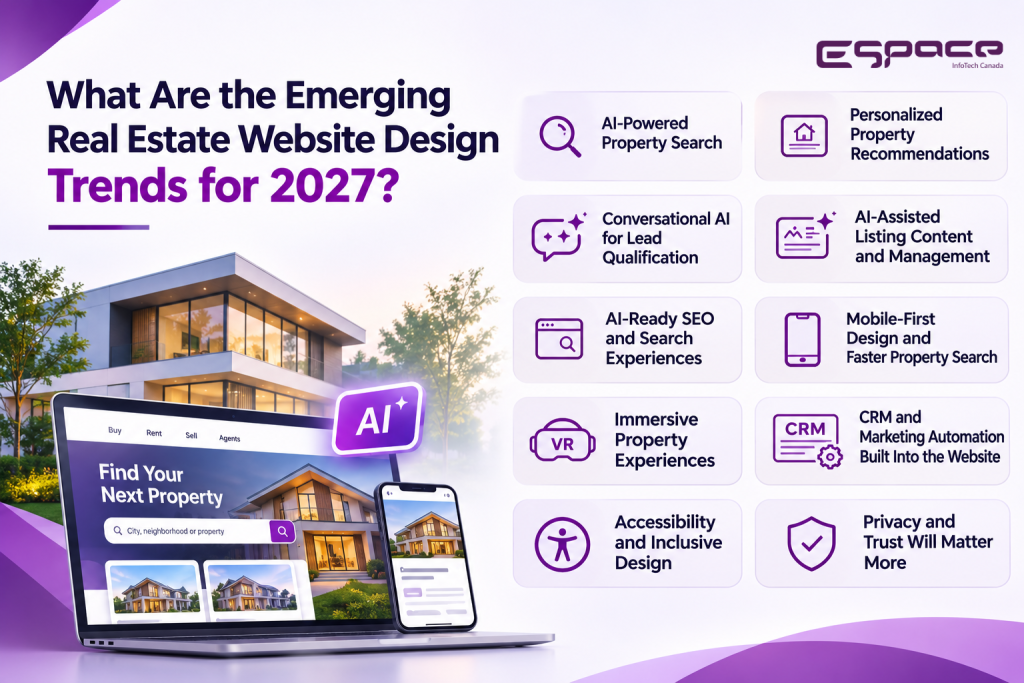
1. AI-Powered Property Search
Traditional property search depends heavily on filters such as location, price, bedrooms, and property type.
AI can make the search experience more conversational.
A visitor might write:
“Show me a two-bedroom condo near downtown with good transit access and a budget under $600,000.”
Instead of requiring the user to manually select multiple filters, an AI-powered search interface can interpret the request and return relevant properties.
The goal is not to remove traditional filters. It is to give users another, more natural way to discover properties.
2. Personalized Property Recommendations
A real estate website can learn from user interactions such as saved properties, searches, viewed listings, preferred locations, and stated requirements.
With the right data architecture, AI can use these signals to recommend properties that are more relevant to each visitor.
For example, a buyer who repeatedly views condos in a specific neighbourhood may see similar properties earlier in their next session.
This turns a website from a static catalogue into a more personalized property discovery experience.
3. Conversational AI for Lead Qualification
A chatbot that simply says “How can I help you?” is not particularly useful.
A better approach is a conversational assistant that can ask relevant questions:
- Are you buying, selling, or renting?
- Which area are you considering?
- What is your approximate budget?
- When are you planning to move?
- Would you like to schedule a viewing?
The answers can help determine whether a visitor is an early-stage browser or a high-intent prospect.
The system can then pass qualified information to the CRM or sales team.
Espace InfoTech’s AI capabilities include NLP, AI assistants, automation, and AI integration into existing web applications and enterprise systems.
Discuss AI features for your real estate website with Espace InfoTech
4. AI-Assisted Listing Content and Management
Property websites contain a large amount of repetitive information.
AI can assist teams with tasks such as:
- Drafting listing descriptions
- Summarizing property information
- Creating alternative descriptions for different audiences
- Identifying incomplete listing information
- Organizing property data
- Supporting content updates
But AI-generated property information should still be reviewed by a responsible human.
That matters because accuracy is particularly important in real estate. CREA’s current guidance stresses transparency, accuracy, accountability, and professional responsibility when AI is used in the sector.
5. AI-Ready SEO and Search Experiences
Real estate websites are also becoming part of a changing search environment.
Google says its AI search experiences continue to rely on foundational SEO practices, including crawlable content, clear technical structure, useful content, internal linking, strong page experience, and accurate structured data. Google also states that there is no special AI markup required to appear in AI Overviews or AI Mode.
For real estate websites, this means SEO should be considered during development rather than added after launch.
Useful pages might include:
- Property pages
- Neighbourhood guides
- Market information
- Buyer resources
- Seller resources
- Agent profiles
- Property type pages
- Frequently asked questions
A well-structured website gives both people and search engines clearer information to work with.
6. Mobile-First Design and Faster Property Search
Real estate browsing is often highly visual, which can create a performance problem.
Large property images, videos, maps, virtual tours, and interactive features can make pages heavy.
A modern real estate website therefore needs to balance visual quality with performance.
Google recommends paying attention to Core Web Vitals, which measure loading performance, responsiveness, and visual stability.
For a property website, that means:
- Compressing and properly sizing images
- Optimizing video delivery
- Using responsive layouts
- Keeping search interactions fast
- Reducing unnecessary scripts
- Monitoring real-world performance
A beautiful property page that takes too long to load is still a poor user experience.
Espace InfoTech’s web development services cover responsive web development, performance optimization, SEO-ready architecture, APIs, databases, and custom web applications.
7. Immersive Property Experiences
High-quality photography will remain important, but real estate websites can increasingly combine images with:
- 360° tours
- Video walkthroughs
- Interactive floor plans
- Maps
- Neighbourhood information
- Virtual staging
- Interactive property comparisons
The key is not to add every visual feature available.
The experience should help the visitor understand the property better.
If a virtual tour makes a listing easier to evaluate, it has a purpose. If an animation only makes the page heavier, it may not be worth adding.
8. CRM and Marketing Automation Built Into the Website
A real estate website should not operate separately from the sales process.
When someone submits an inquiry, saves a property, requests a viewing, or asks for more information, that activity can potentially become part of the CRM workflow.
A connected website can support:
Website → Lead Capture → CRM → Follow-up → Agent → Client
This can reduce manual data entry and make it easier for agents to respond to prospects.
For larger real estate businesses, the website can also connect with email marketing, calendars, analytics, property databases, payment systems, and other business applications.
9. Accessibility and Inclusive Design
Real estate websites should be usable by as many people as possible.
Accessibility includes considerations such as:
- Keyboard navigation
- Readable text
- Appropriate colour contrast
- Descriptive labels
- Accessible forms
- Alternative text for meaningful images
- Clear navigation
The W3C’s WCAG 2.2 provides internationally recognized accessibility guidelines covering areas such as perceivable, operable, understandable, and robust web experiences.
Accessibility should be part of the design and development process rather than something checked immediately before launch.
10. Privacy and Trust Will Matter More
Real estate websites may collect names, email addresses, phone numbers, property preferences, financial information, inquiries, and other personal information.
For Canadian businesses, privacy should therefore be considered when designing forms, CRM integrations, analytics, AI features, and data storage.
PIPEDA establishes requirements for how private-sector organizations subject to the law handle personal information in commercial activities, while provincial privacy laws can also apply depending on the organization and location.
For an AI-powered real estate website, this means businesses should understand:
- What information is collected
- Why it is collected
- Where it is stored
- Who can access it
- How long it is retained
- Which third-party services receive it
Trust is part of the user experience.
WordPress Templates vs Custom Real Estate Website Design
A real estate website design template can be a practical choice for a small business with straightforward requirements.
WordPress can also work well when the primary needs are content publishing, standard property pages, basic forms, and relatively simple functionality.
But custom development becomes more valuable when the website requires:
| Standard Template | Custom Development |
|---|---|
| Basic property listings | Advanced property search |
| Standard contact forms | AI lead qualification |
| Limited integrations | CRM/ERP/API integrations |
| Generic user experience | Personalized user journeys |
| Standard content management | Custom workflows |
| Basic reporting | Custom analytics dashboards |
| Limited automation | AI and workflow automation |
The decision should depend on the business requirements, not simply on which technology is more popular.
If you are unsure whether your project needs WordPress or a custom solution, request a website development consultation from Espace InfoTech.
What Should a Real Estate Website Include in 2027?
A strong real estate website should start with the users and business goals.
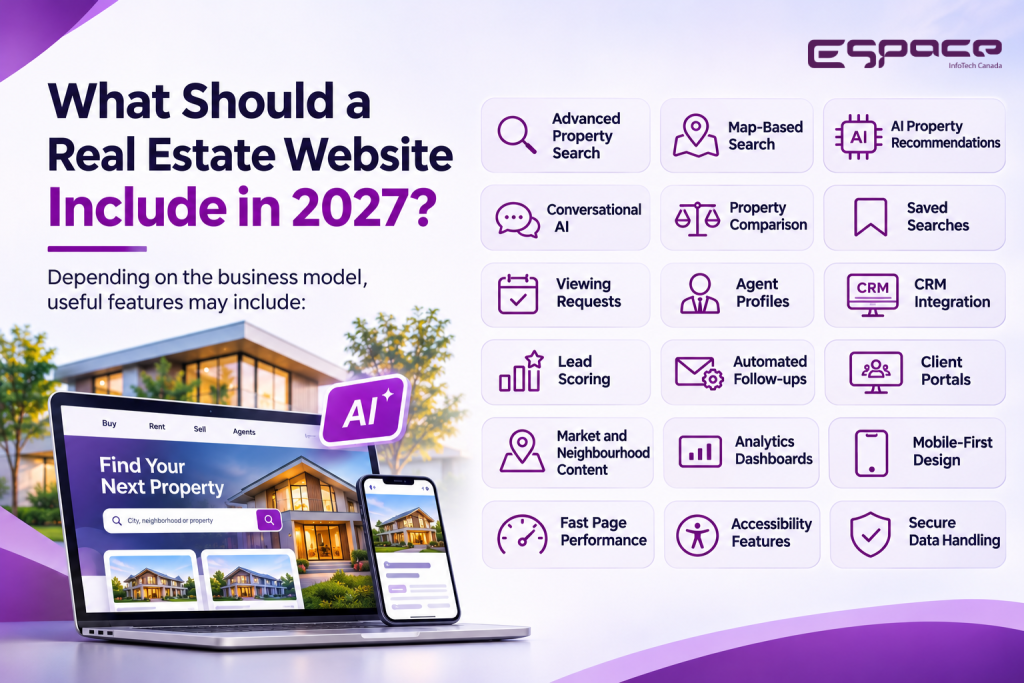
Depending on the business model, useful features may include:
- Advanced property search
- Map-based search
- AI property recommendations
- Conversational AI
- Property comparison
- Saved searches
- Viewing requests
- Agent profiles
- CRM integration
- Lead scoring
- Automated follow-ups
- Client portals
- Market and neighbourhood content
- Analytics dashboards
- Mobile-first design
- Fast page performance
- Accessibility features
- Secure data handling
Not every business needs all of these.
A brokerage website and a PropTech SaaS platform should not have the same architecture simply because both operate in real estate.
How Espace InfoTech Can Help Build an AI-Powered Real Estate Website
Espace InfoTech Canada develops custom websites, web applications, AI solutions, and connected business systems for organizations across industries, including real estate. Its current service portfolio covers web development, AI development, software development, UI/UX, QA, and related technology services.
The company also has existing real estate experience through platforms involving property listings, CRM, client portals, and AI-enabled workflows. Its recent real estate SaaS content specifically covers listing management, CRM, client portals, AI recommendations, lead scoring, document assistance, reporting, and integrations.
For businesses planning a new platform or redesign, Espace can help with:
- Custom real estate website development
- AI-powered property search
- CRM integration
- Property listing platforms
- Customer portals
- AI chatbots
- API integrations
- UI/UX design
- Performance optimization
- QA and testing
- AI integration into existing platforms
Conclusion
AI-powered real estate website design is not about adding a chatbot and calling a website “AI-powered.”
The bigger opportunity is to build a website that understands what users need and helps them move through the property journey with less friction.
For 2027, real estate businesses should watch the development of AI-powered search, personalized recommendations, conversational lead capture, smarter CRM workflows, immersive property experiences, AI-ready SEO, mobile performance, accessibility, and privacy-focused design.
The best websites will not necessarily be the ones with the most technology.
They will be the ones where technology makes the property search and sales process simpler, faster, and more useful.
If you are planning a new real estate website, redesign, or AI-powered property platform, talk to Espace InfoTech about your project.
FAQ
What is an AI-powered real estate website?
An AI-powered real estate website uses artificial intelligence to improve functions such as property search, recommendations, lead qualification, content assistance, customer support, or workflow automation.
Will AI replace real estate agents?
AI can automate repetitive tasks, but it does not remove the need for professional judgment, local expertise, negotiation, and human relationships. CREA specifically emphasizes that REALTORS® remain accountable for their professional responsibilities when using AI.
Is WordPress suitable for a real estate website?
Yes, WordPress can be suitable for businesses with relatively standard website requirements. A custom application may be a better fit when the project requires advanced search, AI, CRM integrations, custom workflows, portals, or complex business logic.
How much does AI real estate website development cost?
There is no standard price. Cost depends on the website’s design, property data, integrations, AI functionality, CRM requirements, user roles, security, and overall complexity.
What will make real estate websites different in 2027?
The strongest shift is likely to be from websites that simply display listings toward websites that actively help users search, compare, understand, and act. AI-assisted search, personalization, automation, performance, accessibility, and connected CRM workflows are all areas worth planning for