

Healthcare Software Integration in Canada: Connecting EHR, Billing, Labs, and Digital Health Systems
For a healthcare provider, having several software systems is not unusual. The problem starts when those systems cannot communicate. Patient information may sit in one platform, appointments in another, billing somewhere else, and lab results in a separate system. Staff then spend time moving information between tools, while patients may experience delays or repeated requests for the same information.
Healthcare software integration Canada is about connecting these systems so relevant data can move securely and reliably between them. Done well, integration can reduce duplicate data entry, support smoother workflows, and give care teams a more complete view of the patient journey.
In Canada, integration also needs to account for privacy, security, provincial requirements, and interoperability standards. Canada Health Infoway is advancing pan-Canadian approaches such as CA Core+, a national set of HL7 FHIR profiles for healthcare data exchange, and CA:FeX, which supports standardized patient data exchange using FHIR. Accelero
Why Healthcare Software Integration Matters in Canada
Healthcare organizations rarely operate with one system. A clinic might use an EHR, appointment platform, billing application, laboratory system, patient portal, and virtual care solution at the same time.
Without integration, these systems can create data silos. A staff member may need to enter the same patient information more than once. A provider may have to switch between applications to find a complete record. A billing team may wait for information from another department before completing a transaction.
Integration creates a connected workflow. It does not mean every system must be replaced. Often, the better approach is to connect the systems already in use through APIs, integration services, or standardized healthcare data formats.
For organizations planning a broader healthcare software project, this can also be part of a custom healthcare software development strategy. Espace InfoTech’s software development services include API and third party integration, system modernization, SaaS platforms, and scalable application architecture. Software Development Services
What Systems Can Healthcare Software Integration Connect?
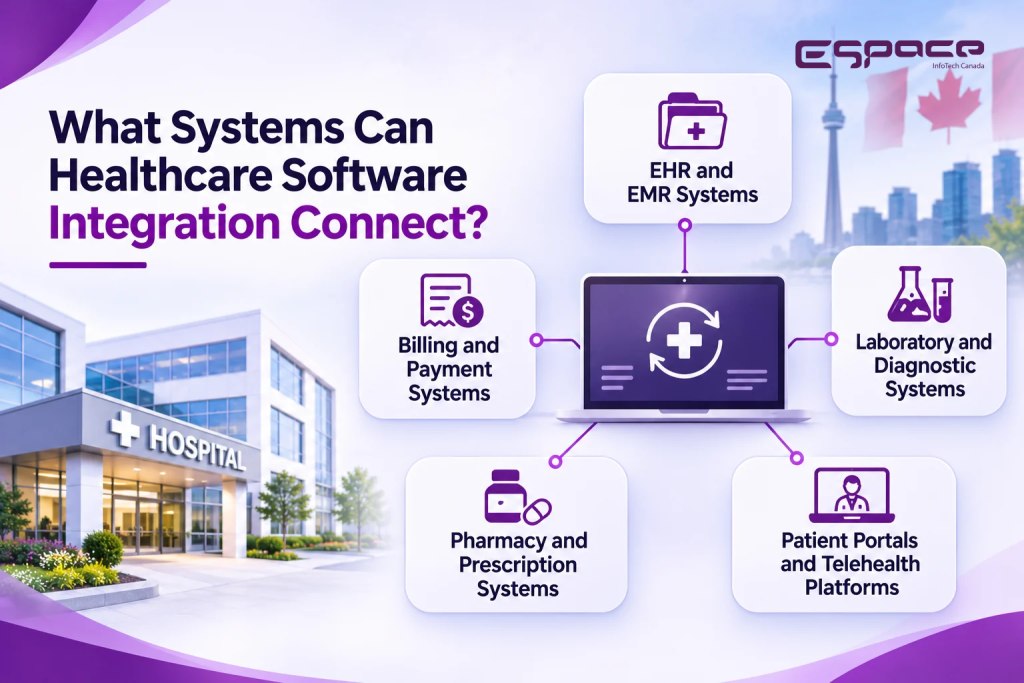
EHR and EMR Systems
Electronic health record and electronic medical record systems can hold important patient information. Integration can allow authorized systems to exchange relevant demographics, clinical information, appointments, referrals, or other data according to the use case and applicable rules.
Canada Health Infoway describes FHIR as a modern standard designed to support exchange between healthcare systems, applications, and devices. Its Canadian CA Core+ work provides standardized FHIR profiles for common healthcare data exchange. Accelero
Billing and Payment Systems
Healthcare billing may involve private payments, insurance processes, invoices, claims, and payment records. Connecting billing with patient and appointment systems can reduce repeated data entry and help keep financial records aligned with services delivered.
Laboratory and Diagnostic Systems
Lab and diagnostic workflows can generate information that needs to reach the right provider or patient facing system. Integration can help move results between authorized systems while maintaining appropriate access controls and auditability.
Pharmacy and Prescription Systems
Where applicable, integration with pharmacy or prescription systems can support information flow around medications and related workflows. These integrations need careful security and data validation because medication information is sensitive.
Patient Portals and Telehealth Platforms
A patient portal or virtual care platform may need access to selected appointment, patient, document, or communication information. Integration can help create a smoother patient experience without creating another isolated database.
What Is HL7 FHIR and Why Does It Matter?
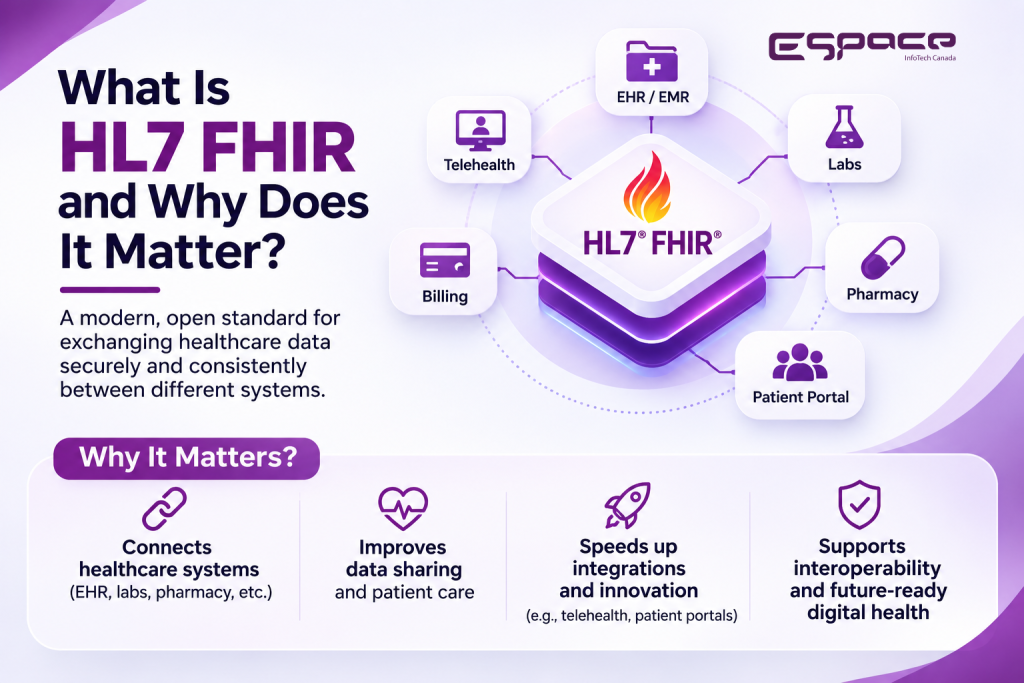
FHIR stands for Fast Healthcare Interoperability Resources. It is a standard developed by HL7 for exchanging healthcare information using modular resources and modern web technologies. Canada Health Infoway describes FHIR as a scalable and adaptable approach to exchanging data between healthcare systems, applications, and devices. Accelero
For Canadian software projects, FHIR can be relevant when a new application needs to communicate with existing digital health systems. CA Core+ defines Canadian FHIR profiles, extensions, terminology, and related artifacts intended to support consistent data exchange across healthcare settings. Accelero
FHIR is not a magic connector that makes every system compatible. The actual integration still requires careful data mapping, authentication, authorization, error handling, testing, and agreement on what information should be exchanged.
Canada Health Infoway’s CA:FeX initiative also focuses on standardized patient data exchange using FHIR and REST based exchange patterns. Accelero
How Does Healthcare Software Integration Work?
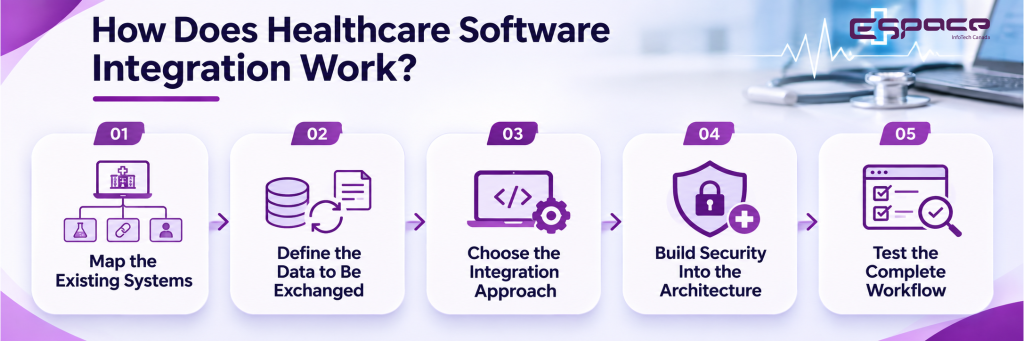
A practical integration project usually follows several stages.
1. Map the Existing Systems
Start by identifying the applications, databases, APIs, users, data flows, and dependencies involved.
2. Define the Data to Be Exchanged
Not every system needs access to everything. Define which data should move, why it is needed, who can access it, and when it should be exchanged.
3. Choose the Integration Approach
Depending on the environment, integration may use APIs, FHIR, HL7 interfaces, middleware, webhooks, secure file exchange, or other mechanisms.
4. Build Security Into the Architecture
Healthcare data requires strong controls. Consider encryption, authentication, authorization, least privilege access, logging, audit trails, and secure secrets management.
Canadian privacy requirements can vary depending on the organization, activity, province, and type of information involved. The Office of the Privacy Commissioner explains that PIPEDA governs personal information handling in commercial activities, while substantially similar provincial privacy laws can apply in several provinces. Privacy Commissioner of Canada
Health Canada also describes privacy impact assessments as a way to identify privacy effects and build privacy protection into new programs and services from the outset. Canada
5. Test the Complete Workflow
Integration testing should cover successful data exchange as well as failures, duplicate records, missing fields, invalid data, permission issues, and system downtime.
Espace InfoTech’s QA services include API, functional, security, performance, and automation testing, which can be valuable for integration heavy healthcare platforms. Healthcare Software Testing & QA Services
CTA Button: Discuss Your Healthcare Integration Requirements → Talk to Espace InfoTech
How Can AI Benefit From Integrated Healthcare Data?
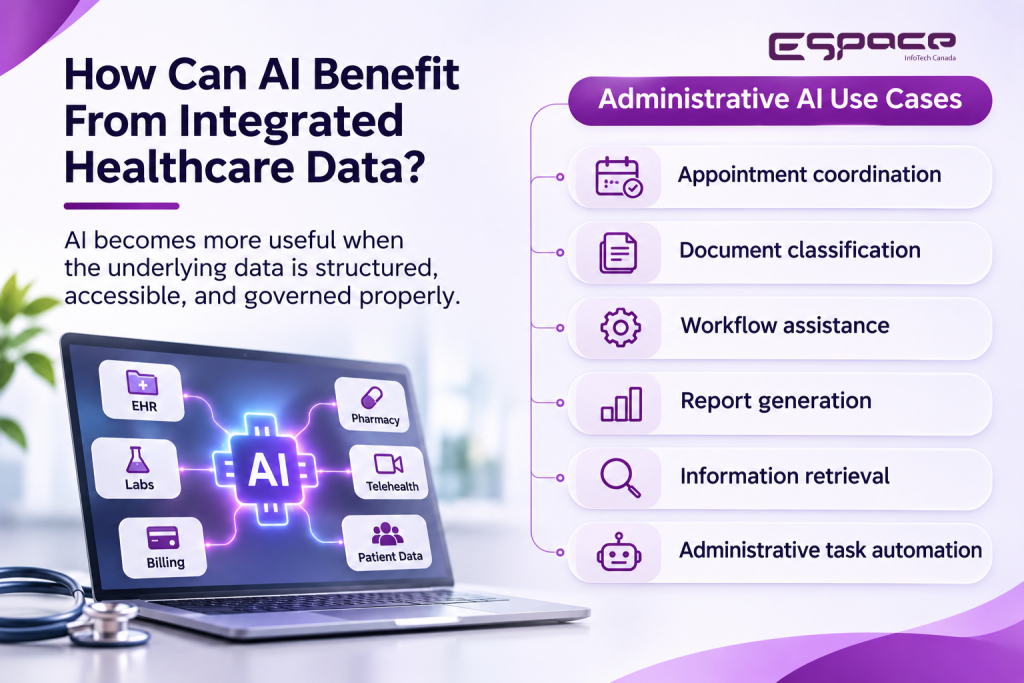
AI becomes more useful when the underlying data is structured, accessible, and governed properly.
For example, an integrated platform could support administrative AI for:
- Appointment coordination
- Document classification
- Workflow assistance
- Report generation
- Information retrieval
- Administrative task automation
But integration does not automatically make data suitable for AI. Healthcare organizations still need to consider data quality, access permissions, privacy, security, human oversight, and the intended use of the AI system.
For clinical decision making or other regulated functions, additional assessment may be required before deployment.
Espace InfoTech also provides AI development focused on automation and decision support, making AI an option to consider after the underlying software and data architecture are properly structured. Espace Infotech
How to Choose a Healthcare Software Integration Partner in Canada
The right partner should understand both software engineering and healthcare workflows.
Look for experience with:
- API and third party integrations
- EHR and EMR connectivity
- Healthcare data security
- FHIR or other interoperability standards
- Cloud and backend architecture
- Automated and integration testing
- Legacy system modernization
- Patient facing applications
A development partner should also be able to explain the integration architecture clearly.
You should know:
What data moves between systems?
Where is it stored?
Who can access it?
How is it protected?
What happens when an integration fails?
If you are evaluating an existing healthcare platform or planning a new one, you can request an integration discussion with Espace InfoTech. Request an Integration Consultation
Conclusion
Healthcare software integration in Canada is ultimately about making different systems work together without compromising privacy, security, reliability, or usability.
The strongest integration strategy starts with the workflow, not the technology. Understand what information needs to move, who needs it, why they need it, and what should happen when something goes wrong. Then choose the right standards, APIs, architecture, and testing approach.
For organizations building or modernizing healthcare software, interoperability can become a foundation for better operations and future digital services.
If your healthcare organization is planning an integration project, Espace InfoTech Canada can help evaluate your existing systems and develop a practical integration approach. Start a Healthcare Software Discussion
FAQ
What is healthcare software integration?
Healthcare software integration connects systems such as EHRs, billing platforms, laboratory systems, patient portals, and other digital health applications so authorized information can be exchanged between them.
Why is FHIR important in healthcare integration?
FHIR provides a standardized way to represent and exchange healthcare information. In Canada, Canada Health Infoway’s CA Core+ work provides Canadian FHIR profiles intended to support consistent interoperability. Accelero
Can an existing EHR be integrated with custom software?
Often, yes, depending on the EHR’s available interfaces, APIs, standards, access policies, and vendor requirements. The integration should be assessed before development begins.
Is healthcare software integration secure?
It can be designed securely, but integration itself does not guarantee security. Authentication, authorization, encryption, logging, access controls, data validation, and appropriate privacy safeguards need to be built into the solution.
How much does healthcare software integration cost in Canada?
There is no fixed price. Cost depends on the number of systems, available APIs, data complexity, security requirements, integration method, testing, and ongoing support.