Launching a new software product is exciting, but getting the application live should not be the final moment to think about security.
Modern applications handle sensitive information such as customer details, payment information, business records, login credentials, and internal data. A single security weakness can expose this information and create serious operational and reputational problems.
This is why security testing should be part of the software development lifecycle.
Testing before launch helps development teams identify vulnerabilities while they still have time to fix them. Instead of discovering security problems after customers start using the application, businesses can address risks before they become production incidents.
For SaaS platforms, e-commerce applications, financial software, healthcare systems, and enterprise applications, security testing is an important part of building trust.
Security testing is the process of examining software, infrastructure, APIs, and related components to identify security weaknesses.
The purpose is to understand how an application could be attacked, what information could potentially be exposed, and whether existing security controls work as expected.
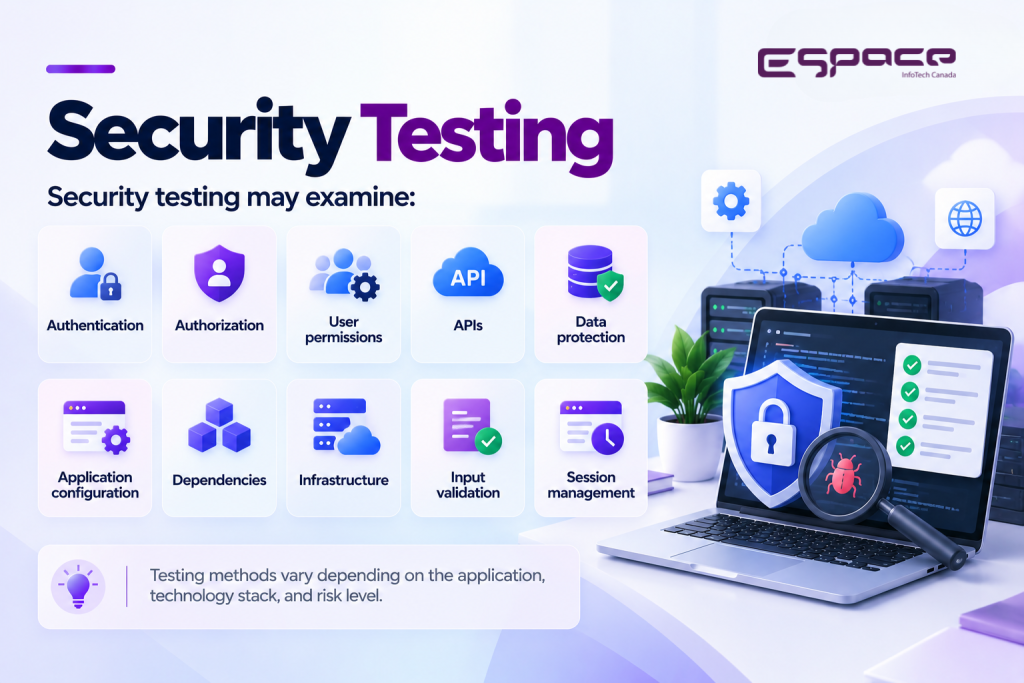
Security testing may examine:
Testing methods vary depending on the application, technology stack, and risk level.
Fixing a vulnerability before launch is generally easier than dealing with the same problem after customers are already using the application.
A production vulnerability may require emergency development work, additional testing, service interruptions, customer communication, and incident response.
Pre-launch testing gives teams an opportunity to identify and prioritize security issues before release.
It also creates a more structured security process rather than treating security as an emergency response activity.
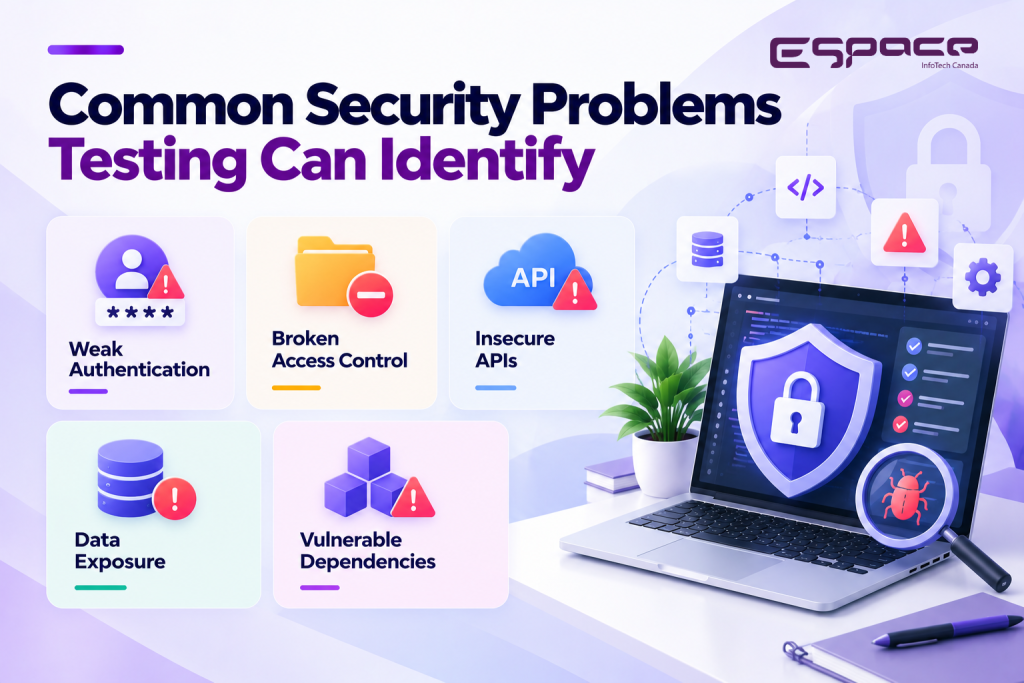
Weak passwords, poor session handling, or inadequate login controls can increase the risk of unauthorized account access.
Security testing can evaluate authentication workflows and identify weaknesses that need attention.
Users should only be able to access information and functions that their role allows.
For example, a regular customer should not be able to access administrative functions simply by changing a URL or API request.
Testing access controls helps identify these types of vulnerabilities.
APIs connect modern applications with mobile apps, payment systems, CRM platforms, databases, and third-party services.
Poorly protected APIs can expose sensitive information or allow unauthorized actions.
API security testing can examine authentication, authorization, input validation, rate limits, and other controls.
Applications may accidentally expose sensitive information through error messages, logs, APIs, databases, or improperly configured storage.
Testing can help identify where sensitive information is unnecessarily accessible.
Modern applications often depend on third-party libraries and frameworks.
An outdated or vulnerable dependency can introduce security risks into an otherwise well-designed application.
Dependency scanning helps development teams identify known vulnerabilities that require updates or further review.

Different testing methods address different types of risks.
Automated vulnerability scanning checks applications, systems, dependencies, and infrastructure for known security weaknesses.
It can provide a useful first layer of security assessment.
Penetration testing involves controlled attempts to identify and exploit vulnerabilities.
A penetration test can provide deeper insight into how multiple weaknesses might be combined by an attacker.
SAST examines source code or compiled code to identify potential security problems during development.
It can help developers detect issues earlier in the development process.
DAST tests a running application from an external perspective.
It can help identify vulnerabilities that may only become visible when the application is operating.
API testing focuses specifically on application interfaces.
It can evaluate authentication, authorization, input handling, data exposure, and other API-specific risks.
Security testing should not happen only one week before launch.
A stronger approach introduces security throughout development.
Identify sensitive data, critical workflows, user roles, and potential security risks.
Use secure coding practices and automated security checks.
Run vulnerability scans, application security tests, API tests, and other appropriate assessments.
Review critical findings, perform penetration testing where appropriate, and verify that important issues have been resolved.
Continue monitoring, patching, testing, and reviewing the application as new threats and software changes emerge.
This approach helps make security a continuous process.
DevSecOps brings security into the development and operations workflow.
Security checks can be integrated into CI/CD pipelines so that code and infrastructure are tested as part of the normal development process.
For example, a deployment pipeline can automatically check:
This allows teams to identify security issues earlier without relying entirely on a final manual review.
AI can support security testing by helping teams analyze large amounts of security information.
AI-assisted tools can help identify unusual patterns, prioritize vulnerabilities, summarize security findings, analyze logs, and support threat detection.
For example, when a security scan generates hundreds of findings, AI can help organize and summarize the results so security and development teams can focus their review.
AI should be treated as an additional security capability, not a replacement for experienced security professionals.
Critical findings should still be validated before remediation decisions are made.
Security testing cannot guarantee that a data breach will never happen.
However, it can reduce exposure by helping organizations discover and fix vulnerabilities before attackers can exploit them.
The strongest approach combines security testing with:
Security is not a single test. It is an ongoing process.
Businesses can start with a simple process.
First, identify the application’s sensitive data and critical functions.
Next, review authentication, permissions, APIs, infrastructure, dependencies, and data storage.
Then perform appropriate automated and manual security testing.
After testing, classify findings based on severity and business impact.
Critical issues should be addressed before launch, while lower-risk findings can be managed through a documented remediation plan.
Finally, retest after fixes to confirm that vulnerabilities have actually been resolved.
Security should not be the last checkpoint before a software launch.
A proper security testing process helps teams identify vulnerabilities earlier, protect sensitive information, and reduce the risks associated with production releases.
The goal is not to create a system that claims to be impossible to attack. The goal is to understand potential weaknesses, fix important vulnerabilities, and continuously improve security.
Espace Infotech Canada Inc. can help businesses build, test, and improve secure applications with security-focused QA, API testing, DevSecOps, cloud security, and custom software development.