

Building Multi-Tenant SaaS for Canadian FinTech: The Architect’s Blueprint
The decision to build a multi-tenant platform is more than a technical choice. For Canadian FinTech startups, it is a regulatory commitment. Currently, the landscape is governed by OSFI, FINTRAC, and Law 25. Therefore, your architecture serves as your first line of defense. It protects against both data breaches and regulatory failure.
For Compliance Managers, Bank IT Heads, and Fintech Founders, “scaling” involves more than speed. It requires maintaining strict tenant isolation. Furthermore, you must navigate the unique constraints of Canadian financial regulation software standards. Consequently, your stack must align with OSFI technology risk management Canada protocols from day one.
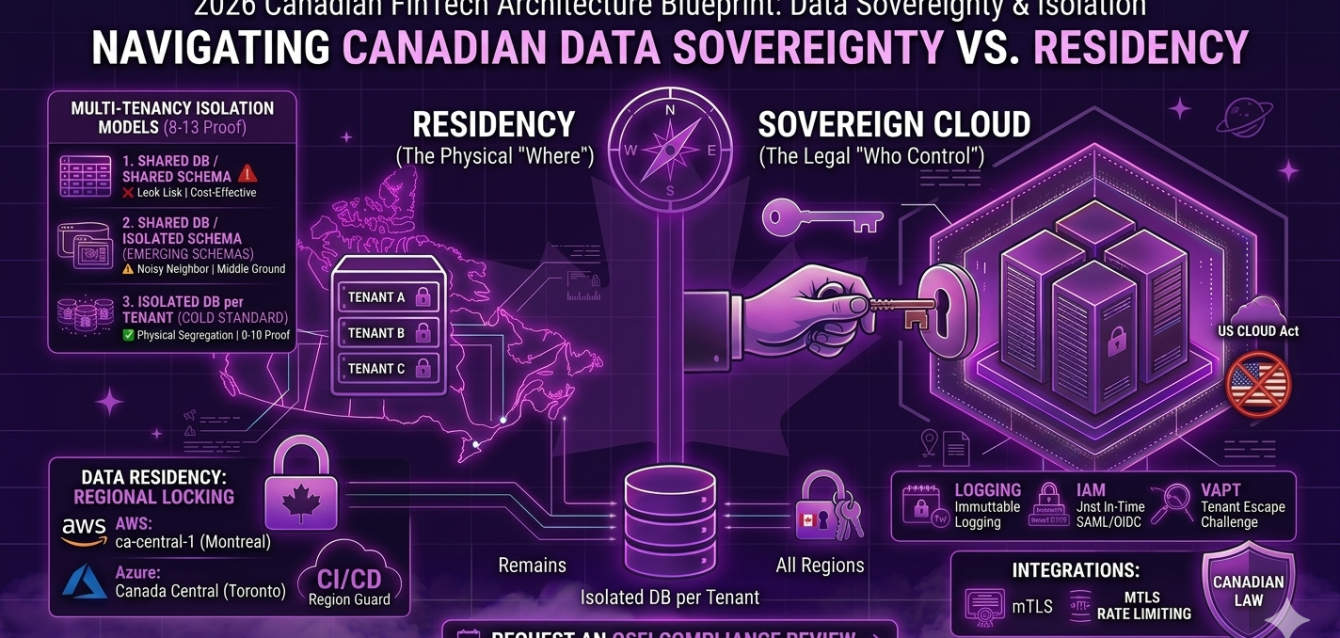
The 3 Multi-Tenancy Models: Choosing Your Compliance Moat
In the world of Canadian FinTech, your isolation model dictates your audit complexity. Here is how the three primary models stack up against OSFI B-13 compliance for vendors.
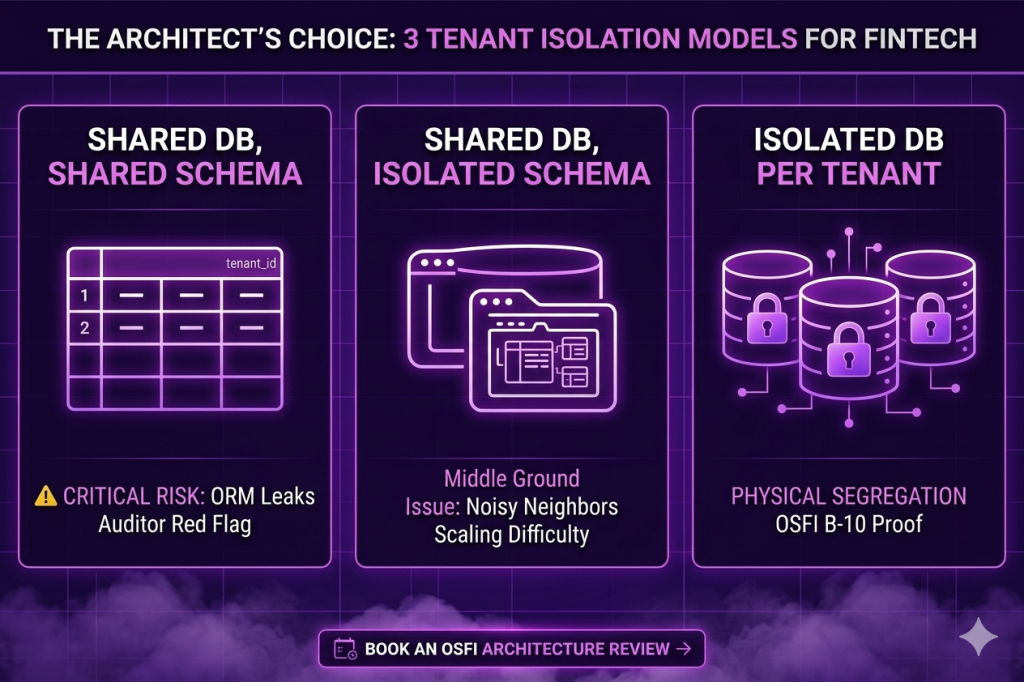
1. Shared Database, Shared Schema (The “Identifier” Model)
All tenants live in the same tables. They are separated only by a tenant_id.
- The Reality: This approach is cost-effective. However, it remains a red flag for FINTRAC auditors and Bank IT Heads.
- The Risk: A single logical error in your ORM results in a catastrophic data leak. In regulated FinTech, accidental exposure is treated as a major breach.
2. Shared Database, Isolated Schema (The “Logical” Model)
Tenants share a database instance but have separate namespaces.
- The Reality: This offers a functional middle ground. It prevents cross-tenant SQL joins.
- The Verdict: It is acceptable for lower-risk apps. Nevertheless, scaling becomes difficult when one “noisy neighbor” impacts others. This often fails the rigorous requirements of OSFI cyber risk guidelines software.
3. Isolated Database per Tenant (The “Gold Standard”)
Each tenant has its own physical or virtual database instance.
- The Reality: We recommend this architecture for “Restricted” or “Highly Confidential” data.
- The Benefit: It provides physical data segregation. If a regulator asks about OSFI B-10 third-party risk management, you can point directly to the infrastructure layer.
Data Residency: The Canadian Constraint
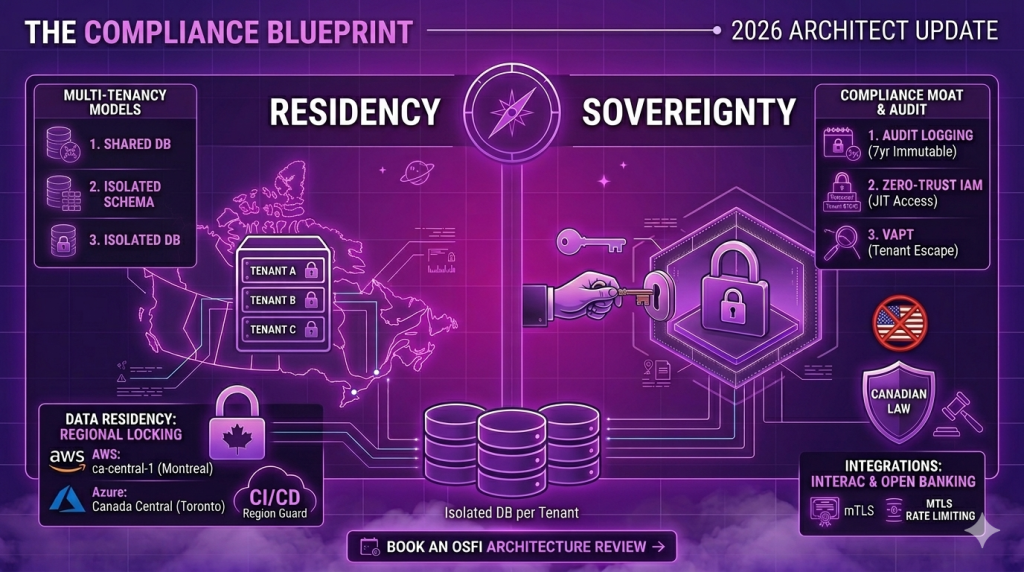
Canadian FinTech SaaS must respect strict data sovereignty. PIPEDA and Law 25 place heavy emphasis on the location of personal financial information (PII).
Regional Locking
You cannot rely on US-based regions. Instead, your infrastructure must be pinned to Canadian soil. Ensure your stack is deployed in:
- AWS: ca-central-1 (Montreal) or ca-west-1 (Calgary)
- Azure: Canada Central (Toronto) or Canada East (Quebec City)
- GCP: northamerica-northeast1 (Montreal) or northamerica-northeast2 (Toronto)
Architect’s Tip: Use CI/CD “Region Guards.” These prevent the accidental deployment of services outside of Canada.
IAM: Zero-Trust at the Tenant Level
Identity and Access Management (IAM) requires a dual-layered approach. You are managing organizations, not just individual users. For a deeper dive, explore our guide on Zero-Trust SaaS for Canadian Regulated Businesses: The Complete Strategy.
The Platform Layer
Internal engineers should never have permanent “God Mode.” Instead, implement Just-In-Time (JIT) access. If a developer needs to troubleshoot, they must request time-limited access. This access must be audited and automatically revoked.
The Tenant Layer
Your platform must support Bring Your Own Identity (BYOID). Large institutions expect SAML or OIDC integration. As a result, your logic must map external identities to internal roles like Compliance Officer or Branch Manager.
Integrating Interac and Open Banking
Integrating with Interac or Bill C-27 APIs adds complexity.
- Mutual TLS (mTLS): Many integrations require certificate-based authentication. Your architecture must manage these certificates on a per-tenant basis.
- Per-Tenant Rate Limiting: Prevent a single client’s API spike from triggering a global lockout.
Audit Logging: The FINTRAC Non-Negotiable
In FinTech, if it wasn’t logged, it didn’t happen. Under FINTRAC and OSFI guidelines, you must maintain immutable records for seven years.
To build a compliant platform, your logging must be:
- Tenant-Aware: Tag every entry with a TenantID.
- Externalized: Ship logs to an “append-only” environment like an S3 bucket with Object Lock.
- Searchable: You must export tenant-specific trails during audits without exposing other clients’ data.
The VAPT Challenge
A standard Penetration Test is insufficient. For multi-tenant FinTech, you need a Vulnerability Assessment and Penetration Test (VAPT) focused on “Tenant Escape.”
Can one tenant admin retrieve data from another tenant_id? Your VAPT report is a critical sales tool. When a bank performs due diligence, this report proves your adherence to OSFI technology risk management Canada standards.
Ready to Build?
Building a multi-tenant platform in Canada requires a “Compliance-First” mindset. Don’t let architectural shortcuts today become the regulatory hurdles that tank your Series A.
Looking for a partner to review your architecture? Talk to Espace InfoTech Canada Inc. about building secure, scalable, and audit-ready SaaS platforms tailored for the Canadian market.