

The New Reality of Canadian Fintech
If you build, sell, or operate software used by a Federally Regulated Financial Institution (FRFI) in Canada-banks, insurance companies, or trust companies-the regulatory landscape shifted beneath your feet on January 1, 2024.
Specifically, the Office of the Superintendent of Financial Institutions (OSFI) transitioned from “suggested best practices” to a rigid, enforceable framework known as Guideline B-13 (Technology and Cyber Risk Management). Furthermore, the updated Guideline B-10 places the burden of third-party risk squarely on the shoulders of the institution. Consequently, they will pass that burden directly to you, their software vendor.
To achieve success as a trusted partner in the Canadian market, vendors must move past generic security claims. Ultimately, understanding the transition from US-centric SOC 2 audits to Canadian OSFI-specific outcomes is the only way to survive a Tier-1 bank audit.
What is OSFI and Why Does it Rule Your Sales Cycle?
First and foremost, OSFI is Canada’s primary federal regulator of the financial sector. While OSFI does not regulate software companies directly, it nonetheless regulates your clients.
For instance, when a Canadian bank considers your SaaS platform, their procurement team isn’t just looking at features; they are performing a B-10 Risk Assessment. As a result if your software architecture cannot support their B-13 compliance requirements, the deal will die in the legal review phase, regardless of how “innovative” your tool is.
The Three Domains of OSFI B-13 Compliance
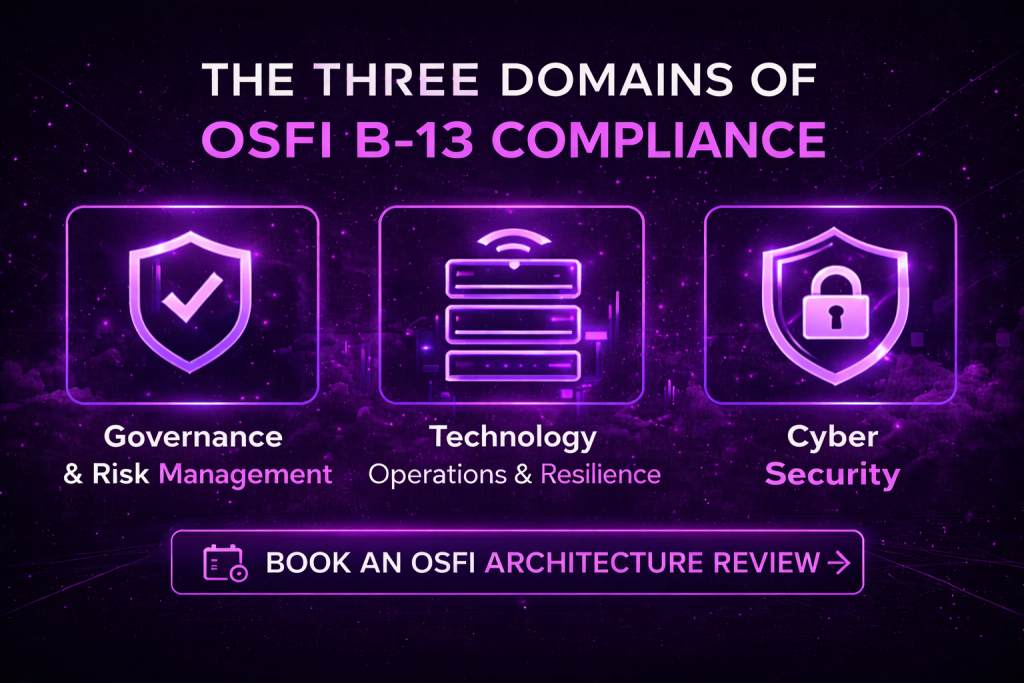
The final B-13 framework is structured into three specific domains. To be considered “OSFI-ready,” your software must demonstrate maturity in each of these areas.
1. Governance and Risk Management
OSFI requires that technology risk is not siloed in the IT department but rather owned by senior leadership and the Board of Directors.
- The Vendor Requirement: Your platform must produce audit-ready reporting. Does your dashboard provide board-level summaries of risk exceptions? Can it export data that fits into a bank’s internal Risk Management Framework (RMF)?
- The Espace Insight: Therefore, we advise vendors to build “Compliance Exports” directly into their admin panels. Auditors want to see that your software allows clients to fulfill their oversight duties without manual data scraping.
2. Technology Operations and Resilience
This domain focuses on a “stable, scalable, and resilient” environment. Essentially, OSFI wants to know: If your software goes down, does the Canadian economy feel it?
- Incident Management: In addition to stability, OSFI mandates strict incident reporting timelines for FRFIs. If your platform suffers a breach, you must have a documented protocol to notify your client within hours, not days.
- Asset Management: You must also maintain a real-time, immutable inventory of all technology assets supporting the FRFI.
- Capacity Management: Your software must demonstrate it can handle peak loads (e.g., end-of-month processing) without degradation.
3. Cyber Security (The “Hardened” Layer)
This is where technical specifications meet regulatory demands. Notably, this is the most scrutinized domain for software developers.
- Identity and Access Management (IAM): Multi-Factor Authentication (MFA) is no longer optional instead it is a baseline requirement. OSFI expects a Least-Privilege model where access is granted only for the duration needed.
- Vulnerability Management: Moreover, you must provide proof of annual Vulnerability Assessment and Penetration Testing (VAPT) performed by an independent third party.
- Data Encryption: OSFI expects data to be encrypted both “at rest” and “in transit” using industry-standard cryptographic protocols (AES-256 or higher).
Critical Compliance Standards Beyond B-13
While B-13 is the “North Star,” your software architecture must navigate a complex web of overlapping Canadian and International standards:
| Standard | Applicability | The “Must-Have” for Vendors |
|---|---|---|
| OSFI B-10 | Third-Party Risk | Proof of your own supply-chain security (who are your vendors?). |
| PIPEDA / Bill C-26 | Data Sovereignty | Guarantee that sensitive Canadian financial data stays on Canadian soil. |
| PCI DSS 4.0 | Payments | Mandatory if your software touches or stores credit card numbers. |
| ISO 27001 | Global Trust | The gold standard for your internal Information Security Management System (ISMS). |
The “Compliance Gap”: Why SOC 2 Isn’t Enough
In many cases, a common pitfall for US-based or international vendors is relying solely on SOC 2 Type II reports. While SOC 2 is a great start, it is by no means a substitute for OSFI compliance.
- Geography: SOC 2 is a US-centric framework. In contrast, it often fails to address Canadian Data Sovereignty requirements.
- Notification: Furthermore, OSFI has specific “Reporting of Technology and Cyber Incidents” mandates that go beyond the typical 72-hour window found in many US contracts.
- Prescription: SOC 2 is flexible, whereas OSFI is highly prescriptive regarding board-level reporting.
The Zero-Trust Solution: Building the “Un-Auditable” Platform
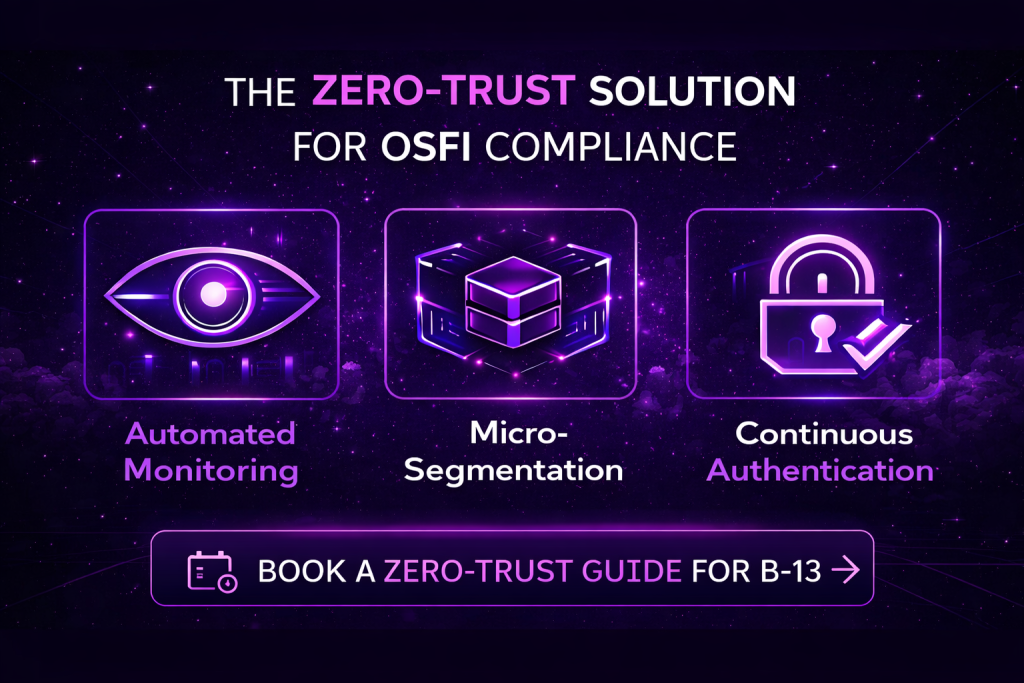
To address these gaps, Zero-Trust architecture is the most efficient path to satisfying OSFI’s requirements. At Espace Infotech, we advocate for a “Never Trust, Always Verify” posture for all regulated software.
How Zero-Trust Maps to OSFI:
- Micro-segmentation: This limits the “blast radius” of a breach, thereby addressing the B-13 Resilience requirement.
- Continuous Authentication: Similarly, every request is verified to satisfy the IAM requirement.
- Automated Monitoring: Finally, continuous logging provides the “immutable audit trail” that bank regulators crave.
What This Means for Your Sales Strategy
If you want to close enterprise deals in Canada, your technical documentation needs to lead with compliance.
Pro Tip: Don’t wait for the client’s legal team to send you a 200-question security questionnaire. Have an OSFI B-13 Whitepaper ready. Show them your VAPT reports, your SOC 2 bridge letter, and your Data Sovereignty map upfront. This builds immediate Trustworthiness (the ‘T’ in E-E-A-T).
Why Partner with Espace Infotech Canada Inc.?
Navigating OSFI guidelines while maintaining a fast development cycle is a balancing act. With this in mind, our team specializes in bridging the gap between high-performance code and regulatory rigor. In short, we don’t just build features; we build compliance-ready ecosystems.
Don’t Build Toward a Gap
If you are building software for the Canadian regulated sector and you are not building on Zero-Trust principles, you are building toward a compliance gap. As regulators like OSFI and the evolving Bill C-26 tighten their grip, the vendors who prioritize security as a core product feature-not an afterthought-will be the ones who dominate the market.
Ready to assess your platform’s OSFI alignment?
Don’t wait for a failed audit to find the cracks in your architecture.
Book a 30-minute OSFI Architecture Review with Espace Infotech’s Technical Team today.
Internal Link Suggestions (Topic Cluster):
- Next Read: [Zero-Trust SaaS for Canadian Regulated Businesses: The Complete Guide]
- Resource: [The Software Vendor’s Checklist for PIPEDA and Bill C-26]