

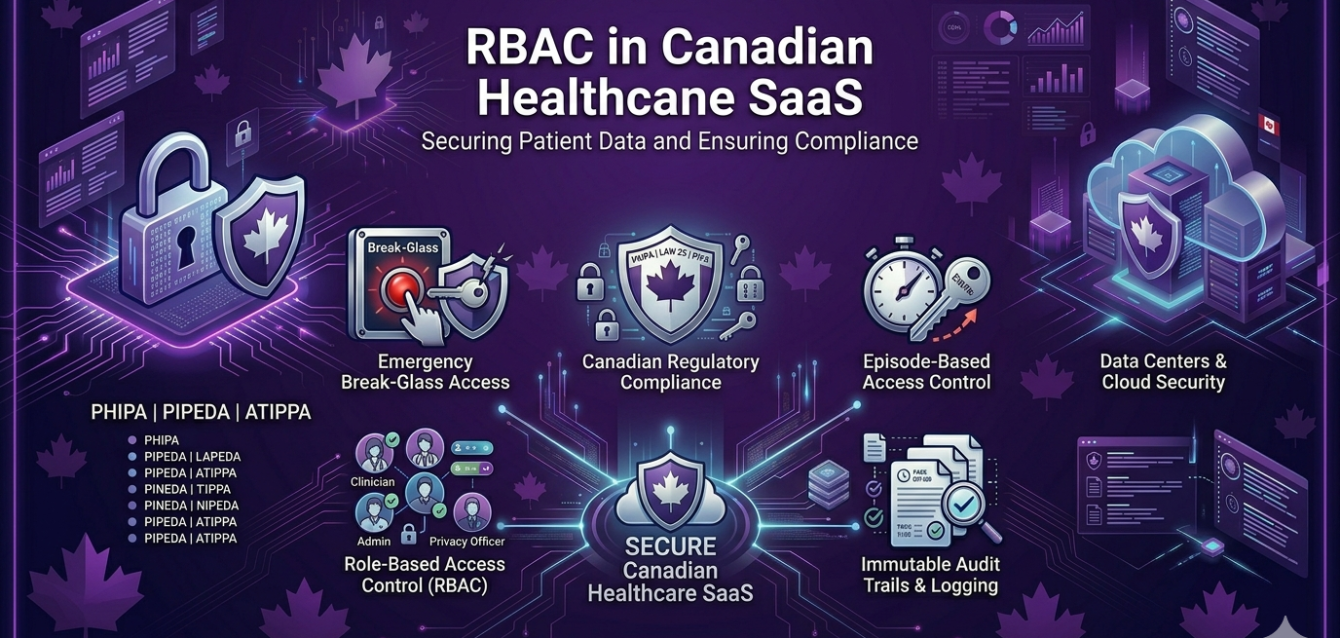
RBAC in Canadian Healthcare SaaS
To begin with, patient data access is not a simple configuration problem. Instead, it is a fundamental architectural issue.
Currently, many Canadian healthcare organizations treat access control as a basic admin setting. For instance, they assume that ticking checkboxes in a software panel guarantees compliance. However, this superficial approach actually leaves massive security gaps.
Consequently, provincial privacy commissioners and PHIPA investigators are identifying these deep vulnerabilities with rapidly increasing frequency.
In response, your architectural approach must shift. In a compliant Canadian environment, access control is not a minor software feature. Consequently, it must be an core architectural commitment.
Specifically, this commitment requires a system designed from the ground up to respect the “Circle of Care.” To remain competitive, your stack must evolve to meet modern healthcare data access control Canada standards.
What Canadian Healthcare Regulations Require
The Canadian regulatory landscape is a patchwork of provincial laws. Navigating them requires precision.
PHIPA (Ontario) and Provincial Equivalents
Ontario’s Personal Health Information Protection Act (PHIPA) is the baseline. Furthermore, British Columbia’s PIPA and Quebec’s Law 25 impose similar constraints. These laws mandate that access to personal health information (PHI) be strictly limited. Only individuals who need the data to perform their specific role should have access. This is the legal foundation for role-based access control PHIPA protocols.
Auditability and Traceability
PHIPA requires that every single access event be logged. You must record who accessed the data and when it happened. Additionally, you must log the location and the specific purpose of the access. This audit log must be available to health information custodians at any time. In some jurisdictions, patients also have the right to review these logs.
Health Canada and Data Integrity
For platforms handling medical devices or clinical trials, Health Canada adds another layer. They mandate end-to-end data traceability. Your system must be able to reconstruct the entire history of a record. Consequently, every modification or deletion event must be immutable and timestamped.
Designing RBAC for the Canadian Clinical Environment
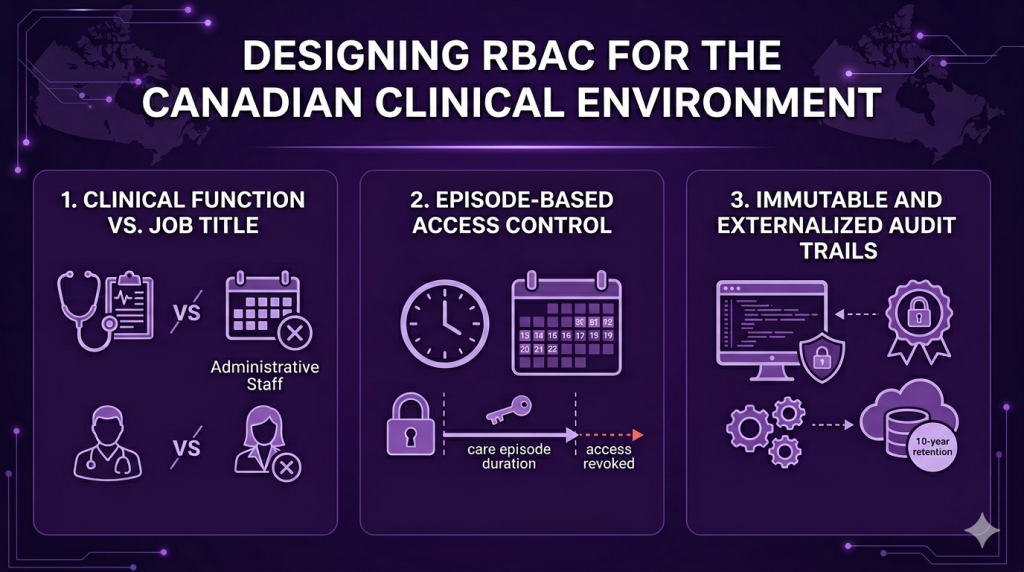
A properly designed RBAC healthcare SaaS Canada system operates on three core principles.
1. Clinical Function vs. Job Title
A generic “Nurse” role is insufficient for PHIPA compliance. A ward nurse needs access to medication records. However, they may not need access to psychiatry notes. Therefore, roles must be defined by specific clinical functions. You must scope access to the minimum data required for that task.
Typical role tiers should include:
- Clinician (Treating): Full access to records for patients under their direct care. This access should be limited to the duration of the care episode.
- Clinician (Consulting): Time-limited, read-only access to specific records. Every view must be logged as a “Consultation Event.”
- Administrative Staff: Access to scheduling and billing data only. They should have zero access to clinical notes or diagnosis codes.
Privacy Officer: Read-only access to audit logs and breach notification records. They should not see patient health data unless an investigation requires it.
2. Episode-Based Access Control
Furthermore, indefinite access remains a major security risk. For example, a physician who treated a patient three years ago should not retain access today.
Instead, modern platforms must implement episode-based access control. Specifically, under this model, the system grants access only for a designated care window. Once this active episode closes, the platform automatically revokes all permissions. Consequently, any subsequent access attempt requires a completely new request. Additionally, the user must provide a fresh, audited justification.
3. Immutable and Externalized Audit Trails
Logging is not an optional feature. In the Canadian context, it is a survival requirement. Every “Read” event is just as important as a “Write” event. To build a compliant platform, your logging must be:
- Tamper-Proof: Standard database logs are vulnerable. If an admin can delete a record, they can hide a breach.
- Externalized: Ship logs to a write-once, read-many (WORM) environment. This ensures logs remain intact even if the main application server is compromised.
- Retention-Ready: Provincial laws often require data retention for at least 10 years. Use an architecture that automates this lifecycle. For a deeper look at these secure layers, see our guide on Zero-Trust SaaS for Canadian Regulated Businesses: The Complete Strategy.
The “Break-Glass” Access Mandate
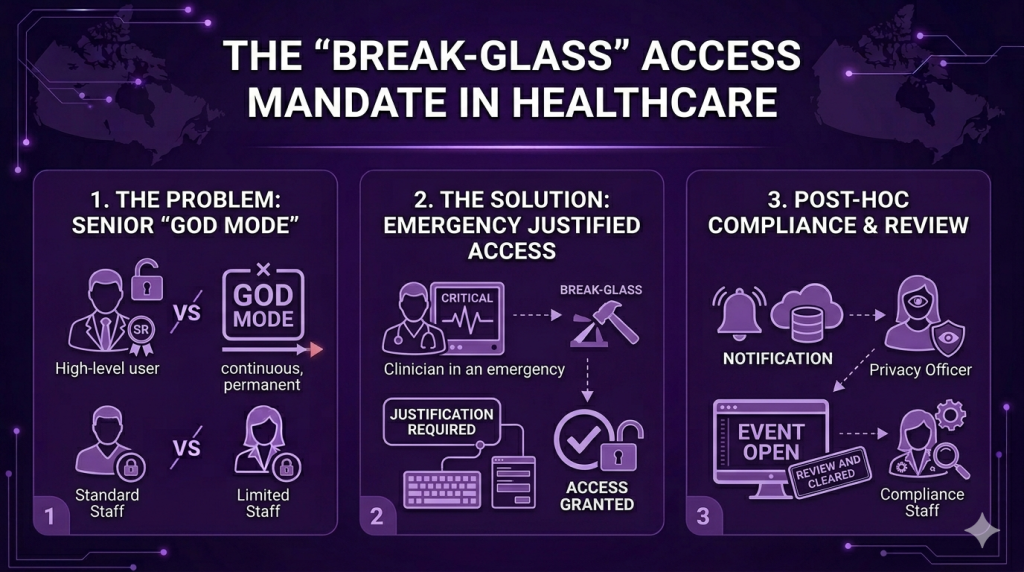
In healthcare, emergencies happen. A clinician might need immediate access to a record they aren’t authorized to see. This is the “Break-Glass” scenario.
Most platforms handle this poorly by giving senior staff permanent “God Mode” access. This violates Zero-Trust principles. Instead, a compliant system should:
- Grant Immediate Access: Patient safety is the priority.
- Require Justification: The user must provide a reason at the moment of access.
- Trigger Notifications: The Privacy Officer should receive an automated alert immediately.
Force Post-Hoc Review: The event must stay in an “Open” state until it is reviewed and cleared by compliance staff.
Why Off-the-Shelf SaaS Often Fails
Many global platforms like Epic or Cerner are designed for the US market. While they meet HIPAA standards, they often fall short of Canadian provincial requirements.
For instance, PHIPA’s audit logging is often more granular than HIPAA’s requirements. Furthermore, Quebec’s Law 25 introduces strict data residency rules. A platform built for the US might replicate data to US-based data centers. This could trigger a major regulatory violation in Canada.
A custom-built or carefully localized healthcare SaaS platform solves these issues. It ensures that healthcare data access control Canada rules are baked into the code, not added as a patch later.
Critical Considerations for HealthTech CTOs
- Data Residency: Is your RBAC metadata stored in Canada? Even if the patient data is local, metadata leakage across borders can be a compliance risk.
- Latency: Does your granular access check slow down the clinician’s workflow? Real-time clinical environments cannot wait for slow authorization queries.
- Scalability: Can your audit log handle millions of access events per day without crashing the database?
Is Your Architecture Compliant?
Building a healthcare platform in Canada requires a “Privacy-by-Design” mindset. Architectural shortcuts in your MVP phase can lead to significant technical debt. More importantly, they lead to regulatory hurdles that could halt your expansion.
At Espace Info Tech, we specialize in building the secure foundations that Canadian HealthTech firms need. We help you navigate PHIPA, PIPA, and Law 25 with confidence.
Don’t leave your compliance to chance. Contact Espace Info Tech for a full healthcare data access architecture review today. We help you build secure, scalable, and audit-ready platforms for the Canadian market.