

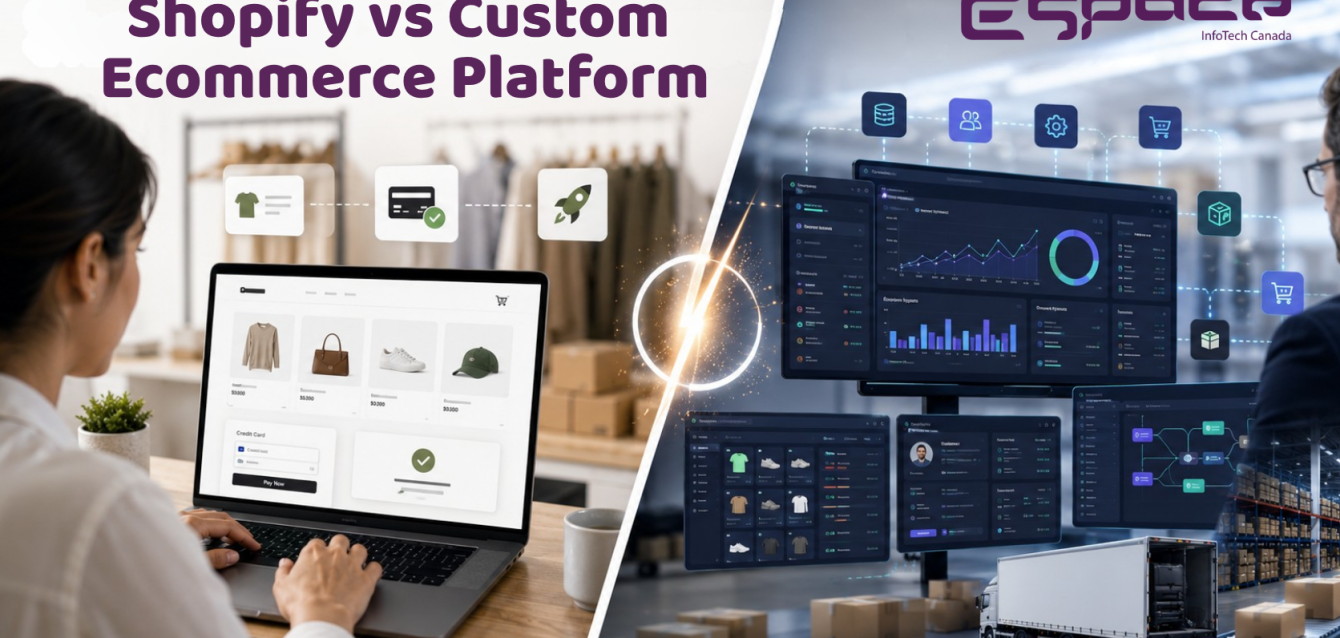
Picking an e-commerce platform isn’t just a website decision. It shapes how fast you launch, how customers experience your brand, how much freedom your marketing team has, how orders get processed, who controls your data, and how much room you have to grow. That’s the real weight behind the Shopify vs custom ecommerce platform question.
Shopify hands you hosting, checkout, themes, apps, and store management out of the box — you’re selling in days, not months. A custom ecommerce platform, on the other hand, gets built around your actual workflows: how your team operates, how your brand needs to feel, where you’re headed in three years. Both approaches work. They just weren’t built to solve the same problem.
Quick Answer: Shopify or Custom Ecommerce?
- Go with Shopify if speed matters most. It’s a solid choice when you want to launch fast, sell fairly standard products, work with ready-made themes, and avoid heavy technical overhead. For a growing business that needs a practical, no-fuss start, Shopify does the job well.
- Go custom if you need flexibility. A custom ecommerce platform makes more sense once you need unique features, non-standard checkout rules, deep integrations, marketplace functionality, B2B ordering, or scalability that a fixed platform structure just can’t give you.
What Is Shopify?
Shopify is a hosted, ready-made ecommerce platform — you’re not building infrastructure from scratch. Storefront design, product management, checkout, payments, shipping, order management, hosting, and security all come bundled in.
That bundling is exactly why so many small and mid-sized companies gravitate toward it. Pick a theme, upload your products, hook up a payment method, add a few apps, and you’re live. No servers to think about, no backend to architect.
What Is a Custom Ecommerce Platform?
A custom ecommerce platform is a selling system built specifically around your customer journey and how your business actually runs internally. That could mean a custom website, a mobile app, an admin dashboard, a vendor panel, inventory workflows, CRM and ERP connections, courier API integrations, a payment gateway, reporting dashboards, automation – whatever your operation actually needs.
The appeal here is control. Custom ecommerce development isn’t boxed in by a fixed platform structure, which matters a lot once you’re dealing with complex pricing rules, B2B ordering, multi-vendor setups, region-specific requirements, or integrations that go deeper than a typical app can reach.
Shopify vs Custom Ecommerce Platform: Quick Comparison
| Factor | Shopify | Custom Ecommerce Platform |
| Setup Time | Faster to launch | Needs planning and development |
| Cost | Lower upfront cost | Higher upfront cost |
| Customization | Theme and app-based | Fully customizable |
| Scalability | Good for standard growth | Better for complex growth |
| Ownership | Platform-dependent | More control over system and data |
| Integrations | App-based | Custom API integrations |
| Maintenance | Easier | Needs technical support |
| Best For | Simple operations | Unique workflows and scaling |
Benefits of Shopify for Growing Businesses
- Faster launch. This is Shopify’s biggest selling point. The infrastructure’s already there, so you skip months of groundwork and get to market quicker than building anything from zero.
- Easy store management. Shopify was clearly built with non-technical teams in mind. Adding products, editing pages, managing orders, running discounts, installing apps – none of it requires touching code.
- A genuinely useful app ecosystem. Reviews, email marketing, upsells, analytics, shipping, loyalty programs, automation – Shopify’s app store covers most of what a standard ecommerce operation needs, and it can save real time getting those pieces in place.
Limitations of Shopify for Growing Businesses

Costs creep up. Shopify looks affordable on day one, but monthly subscriptions, premium themes, paid apps, and transaction fees start adding up as the store scales. It’s rarely as cheap at year two as it was at month one.
And customization has a ceiling. You can restyle the storefront all you want, but deep backend changes, unusual checkout logic, or highly specific business rules often mean workarounds – or apps stacked on apps, which can slow the store down and create messy data trails.
Benefits of a Custom Ecommerce Platform
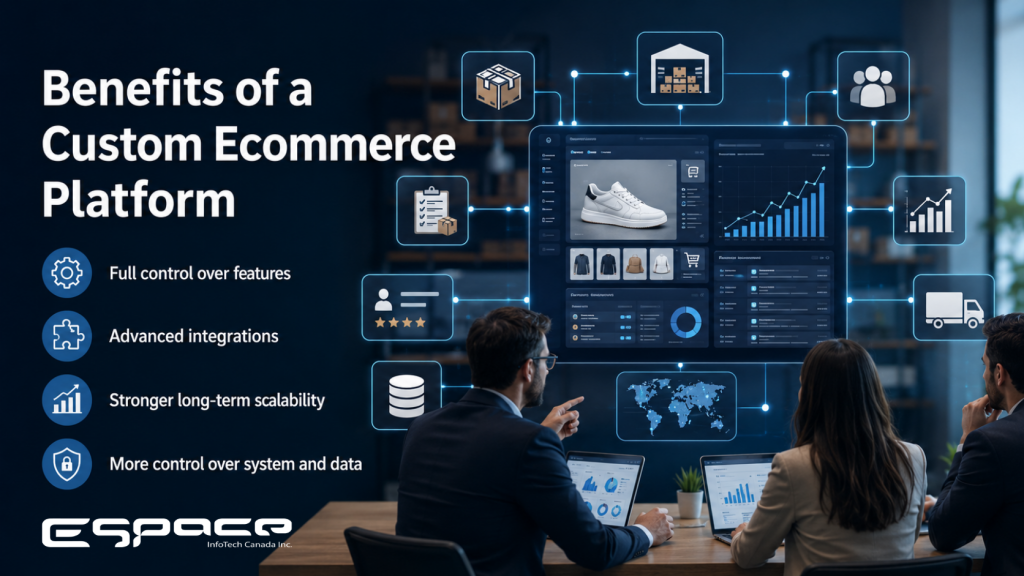
- Full control over features: This is the core advantage of custom ecommerce website development. You decide how the platform looks, how customers buy, how checkout behaves, how the admin panel is laid out, and how data moves between your systems.
- Advanced integrations: A custom build connects directly to ERP, CRM, POS, accounting software, warehouse systems, courier APIs, marketing tools, reporting dashboards – cutting out a lot of manual data entry and giving you a clearer view of the business as a whole.
- Stronger long-term scalability: Done well, a custom system becomes a genuinely scalable ecommerce platform – one that grows alongside the business instead of forcing the business to bend around platform limits.
Challenges of a Custom Ecommerce Platform
The upfront investment is real. Architecture planning, experience design, feature development, testing, launch prep – it all takes more time and budget than spinning up a Shopify store.
Maintenance isn’t optional, either. Unlike Shopify, a custom platform needs ongoing technical support: hosting, updates, security, monitoring, bug fixes, future improvements. Which is exactly why the development partner you choose matters as much as the platform itself.
Cost Comparison: Shopify vs Custom Ecommerce Website
Short term, Shopify wins on cost. Subscription, theme, a few apps, and you’re testing products in the market fast — useful when you’re still validating demand.
Long term, custom development can pull ahead. It costs more to build, but the payoff shows up in ownership, deeper customization, performance control, and integrations that plug directly into how your business already runs.
So the real question isn’t just which option costs less today. It’s which option delivers better value over the next three to five years.
Which Option Is Better for Scalability?
Shopify scales reasonably well for a lot of ecommerce businesses – standard catalogs, direct-to-consumer sales, common integrations. No complaints there.
But once operations get more complex, custom ecommerce tends to hold up better. Expanding into new regions, managing large or fragmented inventory, running B2B and B2C side by side, onboarding vendors, connecting logistics partners, building mobile-first experiences – a custom platform gives you room to maneuver that Shopify’s structure doesn’t always allow.
When Should You Choose Shopify?
Shopify makes sense when you want to launch quickly, run a fairly standard store, keep the technical lift light, and start without a big budget. It also fits teams that would rather lean on ready-made apps than manage hosting and infrastructure themselves.
When Should You Choose a Custom Ecommerce Platform?
Custom makes more sense when your business has workflows that don’t fit a template – advanced integrations, complex inventory, custom pricing logic, marketplace features, mobile app needs, or serious expansion plans on the horizon.
If you’re weighing Shopify alternatives, that’s usually the tell: custom ecommerce is worth considering once the platform needs to function as part of the business engine itself, not just a storefront bolted onto operations.
Why Choose Espace Infotech for Ecommerce Development?
Espace Infotech works with businesses to plan and build digital systems meant to last – custom software, websites, web applications, SaaS platforms, mobile apps, AI solutions, UI/UX design, QA, and IT advisory.
On the ecommerce side, that means helping plan the architecture, design a smoother customer journey, build out custom features, integrate third-party systems, and stay involved after launch. If you’re still weighing Shopify against custom ecommerce – or a hybrid of the two – the team can help you work through the goals, budget, and technical requirements that’ll actually decide the answer.
Conclusion: Shopify or Custom Ecommerce Platform- Which Is Better for Growing Businesses?
There’s no single winner in the Shopify vs custom ecommerce platform debate — and honestly, anyone telling you otherwise is oversimplifying it. Shopify wins on speed and simplicity. Custom ecommerce wins on flexibility, ownership, deeper integrations, and long-term scalability.
The smarter move for a growing business is to look past the launch and think about what operations will look like a couple years out. If your model is simple, Shopify’s probably the right call. If things are getting more complex, custom ecommerce development is likely the stronger foundation.
Frequently Asked Questions
Is Shopify better than a custom ecommerce website?
Shopify wins on quick launch and simple management. A custom ecommerce website wins on advanced features, integrations, ownership, and scalability.
Is custom ecommerce development expensive?
Usually, yes – upfront. But it can deliver stronger long-term value once your business needs custom workflows, automation, and deep integrations.
Can Shopify handle growing businesses?
Yes, for many. But businesses with more complex operations often outgrow it and end up needing a custom solution or custom integrations.
What is the best ecommerce platform for growing business?
Shopify suits simple, fast growth. Custom ecommerce suits complex, scalable, long-term growth.