

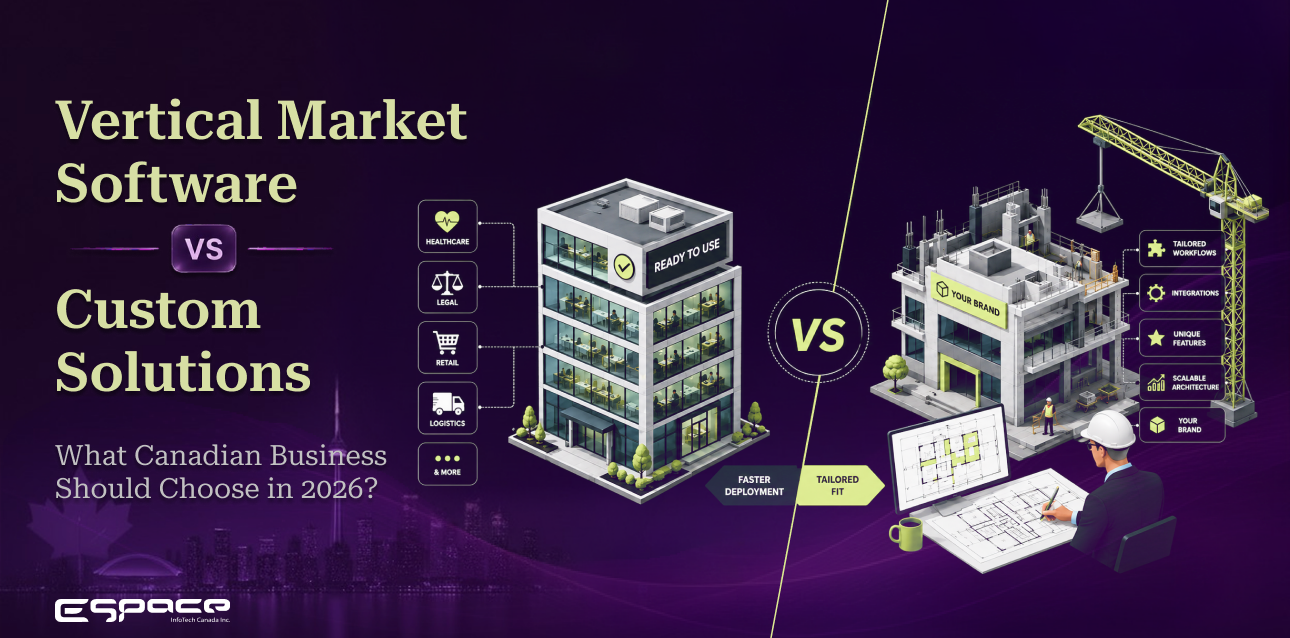
Choosing software is no longer solely an IT decision for Canadian firms. It’s a corporate growth decision.
In 2026, firms are under more pressure than ever to move quicker, to decrease manual work, to improve customer experience, to protect data, and to make smarter judgments. But in the world of software, business owners often have one key question:
Custom Software or Vertical Market Software: What is Best for Your Business?
Both can work but which is right depending on your aims. Vertical software is a prepackaged solution for a certain industry. Custom software is developed for your particular process, team, users, compliance requirements, and long-term growth objectives. This tutorial will describe both solutions in simple ways so that Canadian firms can confidently choose a software in 2026.
What is Custom Software?
Custom software is a software solution that is designed for your business. It’s not a one-size-fits-all solution that you are forced to squeeze into your team, but it’s built around your real workflow, pain points, users and goals. In plain language, custom software is not for everyone, it is for how your firm works.
What is a Custom Site?
A custom website is designed to suit a company’s identity, services, users, features and business goals. A template website might do for a simple online presence, but lots of companies require more than a digital brochure. A custom website can be used for genuine activities, such as booking systems, dashboards, admin panels, payment gateways, CRM connectors, automation, multilingual content and tailored user journeys. That’s why bespoke website creation typically turns into custom software development; the website becomes a working business system, not just a design.
Advantages and Disadvantages of Custom Software Development
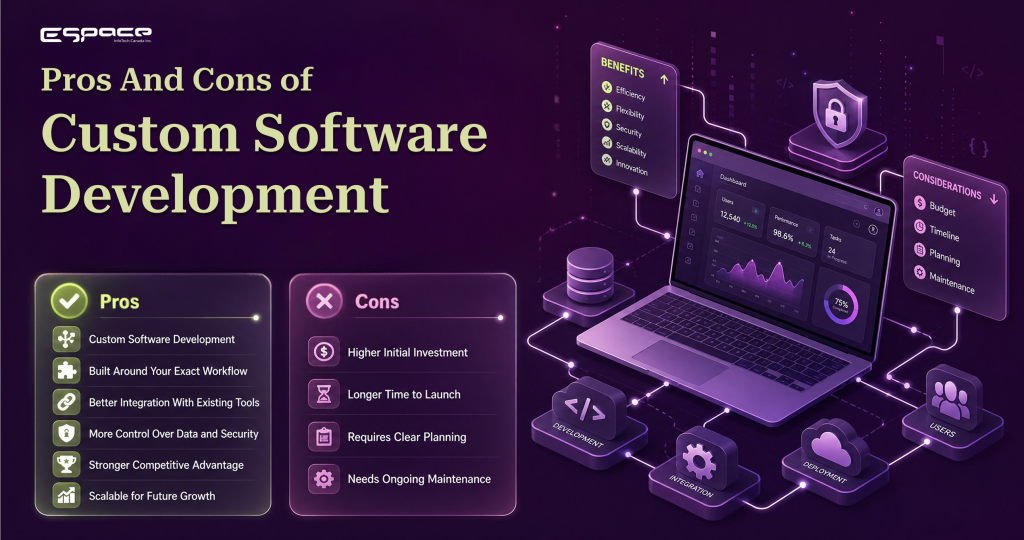
Advantages of Custom Software Development
1. Built to Fit Your Exact Workflow
Best of all, the custom software development process is based on your actual business process.
Your team doesn’t have to customize everything to fit a pre-built tool. The program is built around your approval stages, user roles, reporting needs, price logic, customer journey and internal operations, not the other way around.
It reduces workarounds, duplicate data entry and the perennial “we still use Excel on the side” issue.
2. Improved Integration with Existing Tools
Many organizations already use a variety of technologies for accounting, CRM, HR, inventory, email, sales or customer service. The thing is, most of the time these instruments don’t communicate with one another adequately.
A custom software development company can design integrations between your existing systems. This lets your organization build a unified process rather than bouncing between numerous platforms.
3. Control of Data and Security More
Custom software allows you more control over how your data is kept, accessed and secured.
This can be especially significant for Canadian organizations dealing with privacy, data residency, user permissions and industry-specific compliance requirements. The Canada-based custom software development company can build the system with local commercial and regulatory requirements in mind.
4. Competitive Edge is Stronger
When every company in your field is using the same software, everyone works almost the same manner.
Custom Software You can develop a superior customer experience, faster internal workflow, smarter reporting or unique service model. That disparity can be an advantage in competition. Your software can be a reflection of what makes your firm special.
5. Adequate for Future Expansion
Custom software solution that is well developed can grow with your business.
You can begin with the basic functionalities, then add other modules later, whether they are mobile apps, AI automation, analytics dashboards, customer portals, or complex integrations.
This is what makes custom software valuable to firms who want to thrive in the long term.
Drawbacks of Custom Software Development
1. More Initial Investment
Custom software is generally more expensive at the beginning than buying something that’s already built.
You are paying for discovery, planning, UI/UX design, development, testing, deployment and support. But in the long run, value can be greater, thanks to time savings, error reduction and support for business growth.
2. More Time to Launch
Custom software takes time to design and develop. It’s not something that generally hits the airwaves overnight.
The time it takes is determined by the project’s complexity, features, integrations, design needs, testing, and feedback loops.
3. Requires Well-defined Planning
Custom software is best suited for the business that has clear goals and criteria.
“If you don’t plan correctly, the scope of a project can be confusing and costly. Therefore, selecting a good custom software development agency is vital.
4. Maintenance on an Ongoing Basis
Software systems, like any other, need upgrades, bug repairs, security checks, and enhancements.
With custom software you need a reliable development partner or internal staff to keep the system running over time. The beautiful thing about this is that you can schedule maintenance from day one.
Vertical Market Software – What Is It?
Vertical market software is for a particular industry or type of business. Usually, it contains workflows, forms, reports, dashboards and industry-specific terminology, such as patient records for clinics, or attendance and test management for schools. Vertical software is built for your industry, but not necessarily for your exact business process.
Advantages and Disadvantages of Vertical Market Software

Advantages of Vertical Market Software
1. Faster Starts
Vertical market software is usually out-of-the-box.
You can subscribe, add users, tweak basic settings and get up and running quickly. This might be a huge advantage for firms needing a quick solution.
2. Industry Specific Features
Vertical software is designed for a certain industry. It usually has standard functionality that all organizations in that industry require.
A school administration system, for example, may already have student profiles, attendance, class scheduling and test management. A clinic system could already have appointments, patient records, billing, medicines.
3. Lower Initial Investment
Vertical software products are typically sold as subscriptions or licenses. This frequently leads to a lower initial cost than developing specialized software from scratch.
This can be useful for small enterprises and start-ups.
4. Support and Updates from Vendor
Vertical software vendors typically provide customer support, documentation, training, and regular upgrades.
It relieves pressure on your own team and simplifies the management of everyday software use.
5. Comparable Companies Tested
Vertical software is typically already being utilized by other companies in your industry. That means that a lot of the common use cases should already be taken care of.
This assures business owners that the software has been tried in similar circumstances.
Cons of Vertical Market Software
1. Lack of Flexibility
Vertical software is built for an industry, not your particular organization.
If your workflow is not the industry standard, then your staff might have to adjust to the program. This might cause annoyance and inefficiency over time.
2. Features Missing
Even though the program addresses most industry demands, it may not have the specific features your organization needs.
You may have to patch the holes with spreadsheets, manual methods, supplementary tools or workarounds.
3. Limitations of Integration
Some vertical software solutions have limited APIs or legacy integration capabilities.
This can make it tough to integrate the program with your CRM, ERP, accounting system, website, mobile app or reporting dashboard.
4. Vendor Lock in
With vertical software you are very dependent on the seller.
Your data, workflow, pricing, updates and future features are tied to the vendor’s plan. If the vendor doesn’t put priority on something your firm needs, you could have to wait or compromise.
5. Subscription Fees May Go Up
Vertical software may seem like a low-cost option at first, but prices can add up as your company grows.
Some systems charge per user, feature, storage, transaction or usage. Monthly or yearly fees might add up over the long run.
Custom Software vs Vertical Market Software Comparison Table Factor

Who Requires Custom Software Development?
For companies with complicated operations, specialized procedures, or long-term digital expansion objectives, custom software development is usually the best option. This is especially handy if your staff is overly dependent on spreadsheets, using too many different tools, or frustrated with software that doesn’t reflect the way your organization truly works.
You might also want custom software if your firm needs customer portals, staff portals, vendor portals, custom pricing rules, approval workflows, enhanced reporting, robust data management or role-based user permissions. It’s also a good fit for firms who want to build a SaaS product, link web and mobile apps, automate manual activities, add AI-powered features, or create bespoke dashboards.
Custom software development services can be a valuable investment for Canadian startups, SMEs and expanding enterprises when technology is no longer a support tool, but a vital aspect of corporate growth, efficiency and competitive advantage.
Who Needs Vertical Market Software?
If your organization has similar demands in your sector and you want a quick, inexpensive solution, vertical market software is a great option. If your workflow is similar to other organizations in the field, you don’t require a lot of specific features, your integration needs are straightforward and you’re happy to change your process to fit the software, it works well. It can also be handy for small enterprises or companies trying out a new operation before investing in a custom solution. For instance, a small clinic can utilize off-the-shelf clinic administration software, a retail outlet can go for a vertical POS system, and a training facility can start with a generic education management platform. In other words, vertical software makes sense when the need for speed, cost and standard industry features outweighs the need for complete customization.
Can Businesses Use Both?
Yes, often the greatest solution is not custom software or vertical software, it’s a combination of the two. Companies can then use vertical software for the typical demands of the industry, and then develop custom tools around it when they need additional flexibility, integration or control. This hybrid strategy reduces risk, saves time and helps firms achieve the right solution without reinventing the wheel.
Conclusion
The decision between vertical software and custom software basically comes down to business fit.
Vertical software provides pre-built industry capabilities, faster setup and a better initial cost. But custom software offers flexibility, control, scalability and a solution built around your unique workflow. Canadian organizations need to assess their present process, pain areas and long-term costs before making a decision. A reputable partner like Espace InfoTech can aid you with the decision and design the perfect solution.
At the end of the day software should make job easier, not harder.
Frequently Asked Questions
- Does custom software cost more than vertical market software?
- Is it possible for a firm to use vertical and bespoke software?
- Which sectors in Canada can use custom software development?
- Tips on selecting the top software development firm in Canada?