Businesses in 2026 are facing increasing pressure to operate faster, reduce costs, and make smarter decisions using real-time data.
Traditional ERP systems helped organizations manage finance, inventory, HR, sales, procurement, and operations in one place. However, many companies now expect more than data storage and reporting.
They need systems that can understand patterns, automate repetitive work, predict future outcomes, and support better decisions.
C'est ici qu'entrent AI in ERP is becoming a major transformation.
By combining artificial intelligence with enterprise resource planning systems, businesses can move from reactive operations to intelligent and proactive management.
AI-powered ERP platforms can help companies automate workflows, improve forecasting, reduce manual effort, and create more efficient business processes.
What Is AI in ERP?
AI in ERP refers to the integration of artificial intelligence technologies into ERP systems to improve automation, analysis, and decision-making.
Traditional ERP systems collect and organize business data. AI adds intelligence by analyzing that data and helping users identify opportunities, risks, and next actions.
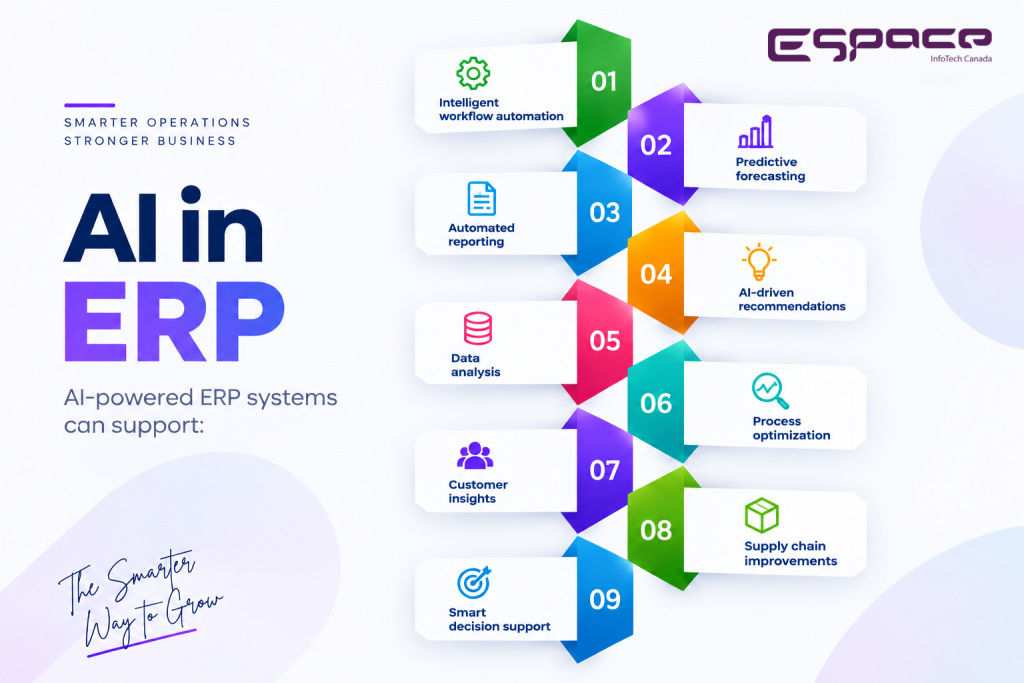
AI-powered ERP systems can support:
Intelligent workflow automation
Predictive forecasting
Automated reporting
AI-driven recommendations
Data analysis
Process optimization
Customer insights
Supply chain improvements
Smart decision support
The goal is not to replace employees. The goal is to help teams work faster and focus on higher-value activities.
Modern businesses generate massive amounts of data every day. Sales transactions, customer interactions, inventory movement, financial records, employee activities, and operational metrics all create valuable insights.
However, many organizations struggle to turn this data into action.
Common challenges include:
Manual data entry
Slow reporting processes
Limited visibility across departments
Delayed decision-making
Inefficient workflows
Difficulty predicting demand
Repetitive administrative tasks
AI in ERP helps solve these challenges by transforming business data into useful insights and automated actions. Instead of waiting for reports at the end of the month, companies can identify trends and opportunities in real time.
Intelligent Workflow Automation
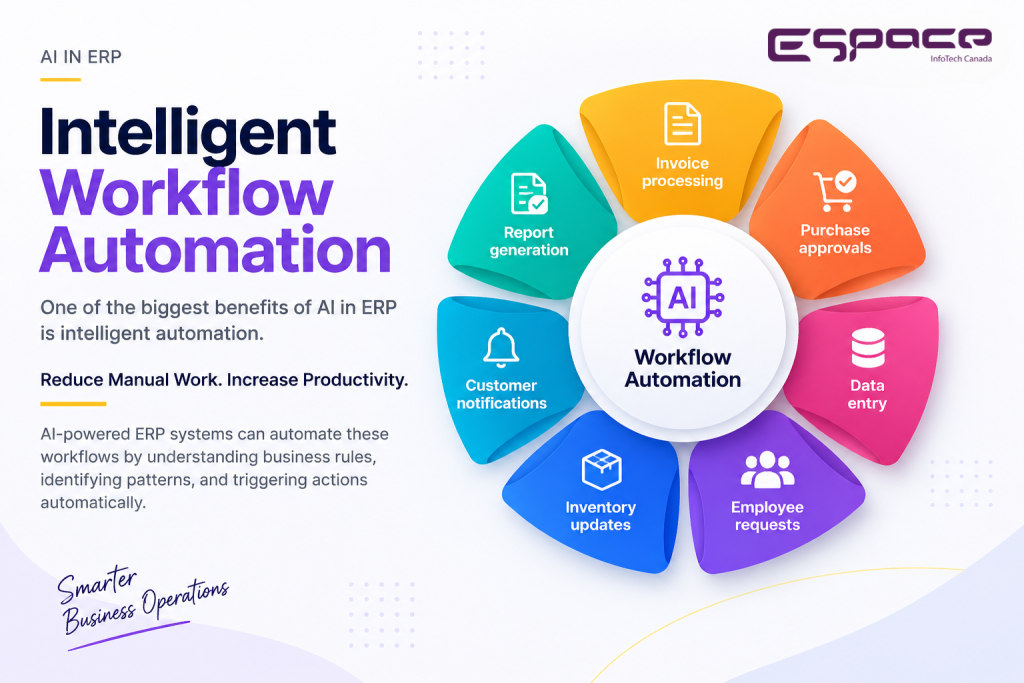
One of the biggest benefits of AI in ERP is intelligent automation.
Many business processes involve repetitive tasks that consume employee time.
Examples include:
Invoice processing
Purchase approvals
Data entry
Employee requests
Inventory updates
Customer notifications
Report generation
AI-powered ERP systems can automate these workflows by understanding business rules, identifying patterns, and triggering actions automatically.
For example, an ERP system can detect low inventory levels and automatically recommend a purchase order. It can identify unusual expenses and notify the finance team. It can also automate approval workflows based on predefined conditions.
This reduces manual effort and improves operational efficiency.
Predictive Forecasting with AI
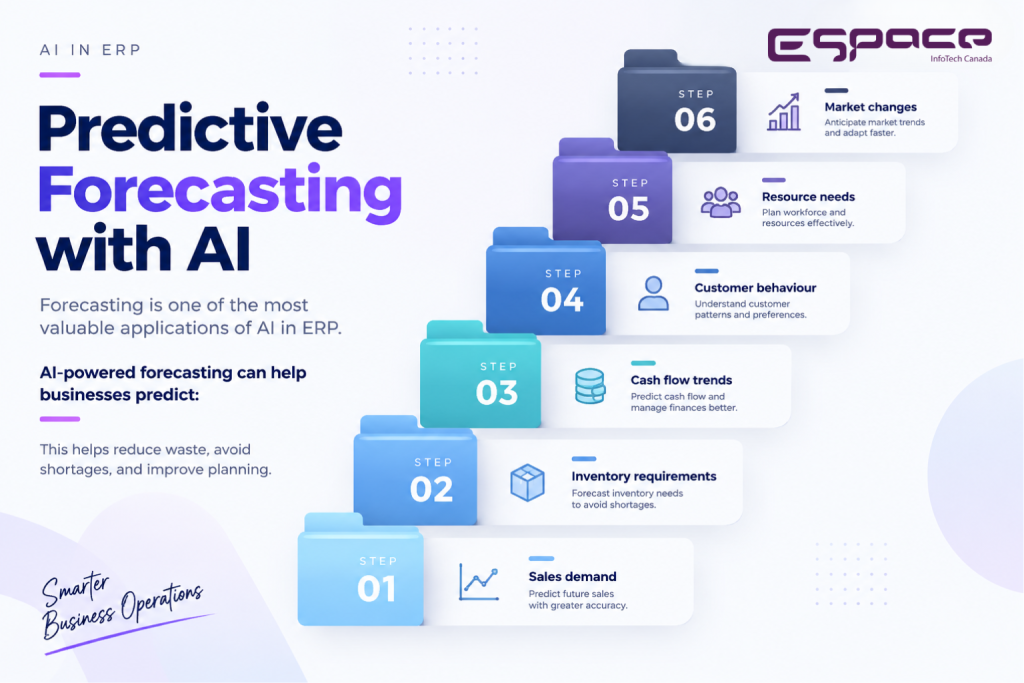
Forecasting is one of the most valuable applications of AI in ERP.
Traditional forecasting often depends on historical reports and manual analysis. AI can analyze larger amounts of data and identify patterns that humans may miss.
AI-powered forecasting can help businesses predict:
Sales demand
Inventory requirements
Cash flow trends
Customer behavior
Resource needs
Market changes
For example, a retail company can use AI to predict which products may have higher demand in upcoming months and adjust inventory accordingly. This helps reduce waste, avoid shortages, and improve planning.
AI-Powered Business Intelligence
ERP systems already contain valuable business data, but many organizations struggle to extract meaningful insights. AI can make ERP analytics more accessible.
Instead of reviewing complex dashboards manually, business leaders can ask questions and receive summarized insights.
For example:
Which products generated the highest revenue this quarter?
Why did operational costs increase?
Which department requires attention?
AI can analyze ERP data and provide understandable answers, helping managers make faster decisions.
AI in ERP for Supply Chain Optimization
Supply chains are becoming more complex, and businesses need better visibility. AI-powered ERP systems can analyze supplier performance, inventory levels, demand patterns, transportation data, and operational risks.
This can help companies:
Improve inventory planning
Identify supply chain risks
Optimize procurement
Reduce delays
Improve supplier management
For manufacturing, retail, logistics, and distribution companies, AI can create a more responsive supply chain.
AI Customer and Sales Insights
ERP systems are not only for internal operations. They can also improve customer relationships.
AI can analyze customer purchasing patterns, sales history, communication records, and preferences.
Businesses can use these insights to:
Identify valuable customers
Predict buying behaviour
Improve sales strategies
Personalize customer experiences
Recommend relevant products or services
When ERP connects with CRM systems, businesses gain a complete view of their customers.
AI Implementation Challenges in ERP
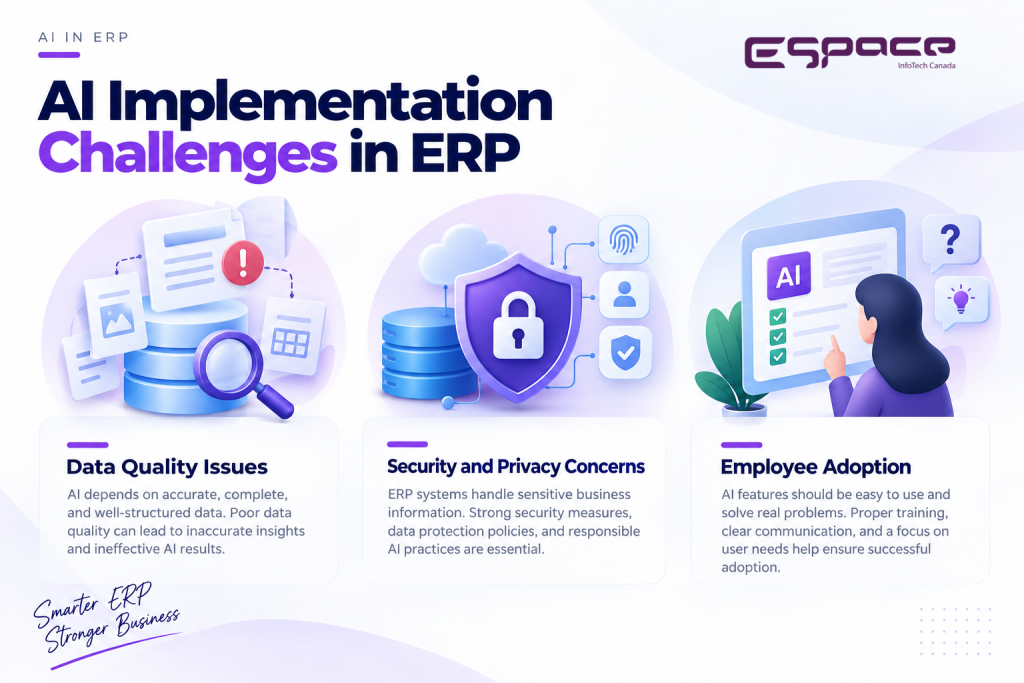
While AI in ERP provides significant benefits, implementation requires careful planning. Common challenges include:
Data Quality Issues
AI depends on accurate data. Poor-quality, incomplete, or disconnected data can reduce AI effectiveness. Businesses should improve data management before implementing advanced AI features.
Security and Privacy Concerns
ERP systems often contain sensitive business information, including financial records, employee data, customer information, and operational details. Companies need strong security practices such as access control, encryption, monitoring, and proper data governance.
Employee Adoption
Technology alone does not guarantee success. Employees need proper training and understanding of how AI improves their work.
AI should support employees, not create unnecessary complexity.
How to Successfully Implement AI in ERP
A successful AI ERP strategy should start with business goals.
Companies should:
Identify repetitive processes that can be automated
Review existing ERP data quality
Choose AI features that solve real problems
Start with smaller AI implementations
Train employees properly
Monitor results and improve continuously
The best AI implementations focus on business value, not just technology.
Why Custom ERP Development Matters
Every business has unique workflows, reporting needs, integrations, and operational challenges. Ready-made ERP solutions may provide general features, but custom ERP development allows companies to build systems around their specific processes.
Custom AI-powered ERP solutions can include:
Industry-specific workflows
Custom dashboards
AI-powered reporting
Automated approvals
CRM and third-party integrations
Advanced analytics
Un contrôle d’accès fondé sur les rôles
For businesses looking to gain a competitive advantage, a customized ERP approach provides more flexibility and scalability.
Conclusion
AI in ERP is changing how businesses operate in 2026.
ERP systems are moving beyond traditional data management and becoming intelligent platforms that can automate processes, predict trends, and support smarter decisions.
The future of enterprise software is not only about collecting data. It is about understanding data and using it effectively.
Businesses that combine ERP, AI, and automation will be better positioned to improve efficiency, reduce operational costs, and adapt faster in a changing market
FAQ
What is AI in ERP?
AI in ERP means integrating artificial intelligence into ERP systems to automate workflows, analyze business data, improve forecasting, and support decision-making.
How does AI improve ERP systems?
AI improves ERP systems by automating repetitive tasks, predicting trends, providing insights, optimizing workflows, and improving business visibility.
What are examples of AI in ERP?
Examples include predictive forecasting, automated reporting, intelligent approvals, AI recommendations, supply chain optimization, and customer insights.
Is AI replacing traditional ERP systems?
No. AI enhances traditional ERP systems by adding intelligence, automation, and advanced analytics.
Why should businesses consider custom AI ERP development?
Custom AI ERP development allows businesses to build solutions around their unique workflows, integrations, reporting requirements, and industry needs.
Can Espace Infotech Canada develop AI-powered ERP solutions?
Yes. Espace Infotech Canada Inc. helps businesses develop custom ERP systems with AI automation, analytics, integrations, and intelligent workflows.