

Best Custom Website Development Service in Canada: A Practical Guide for Businesses
A website can look polished and still create problems for the business behind it.
Maybe it loads slowly. Perhaps updating content requires a developer every time. Leads arrive through forms but never reach the right CRM. Search engines struggle to understand the site structure. Or the website works well today but becomes difficult to extend six months later.
That is why choosing a custom website development service in Canada should involve more than comparing design portfolios.
A strong development partner should understand how your website supports marketing, sales, operations, customer experience, search visibility, security, and future growth.
The real question is not simply, “Who can build our website?”
It is, “Who can build a website that still makes sense as our business grows?”
What Is Custom Website Development?
Custom website development means designing and engineering a website around a company’s specific requirements instead of forcing those requirements into a fixed template.
That could mean developing a corporate website with specialized lead workflows, a customer portal, an online booking system, a product catalogue, a multilingual platform, or a website connected to internal business software.
A custom project may include:
- UI/UX design
- Front-end development
- Back-end development
- Content management
- API integrations
- CRM integration
- eCommerce functionality
- Analytics
- Technical SEO
- Accessibility
- Security
- Optimisation de la performance
- Cloud deployment
The goal is not customization for the sake of customization. The goal is to remove technical limitations that interfere with the business.
What Makes a Website Development Service “Best” for Your Business?
There is no single development company that is automatically the best fit for every organization.
A better way to evaluate a provider is to examine how well its capabilities match your business, users, technical requirements, and long-term plans.
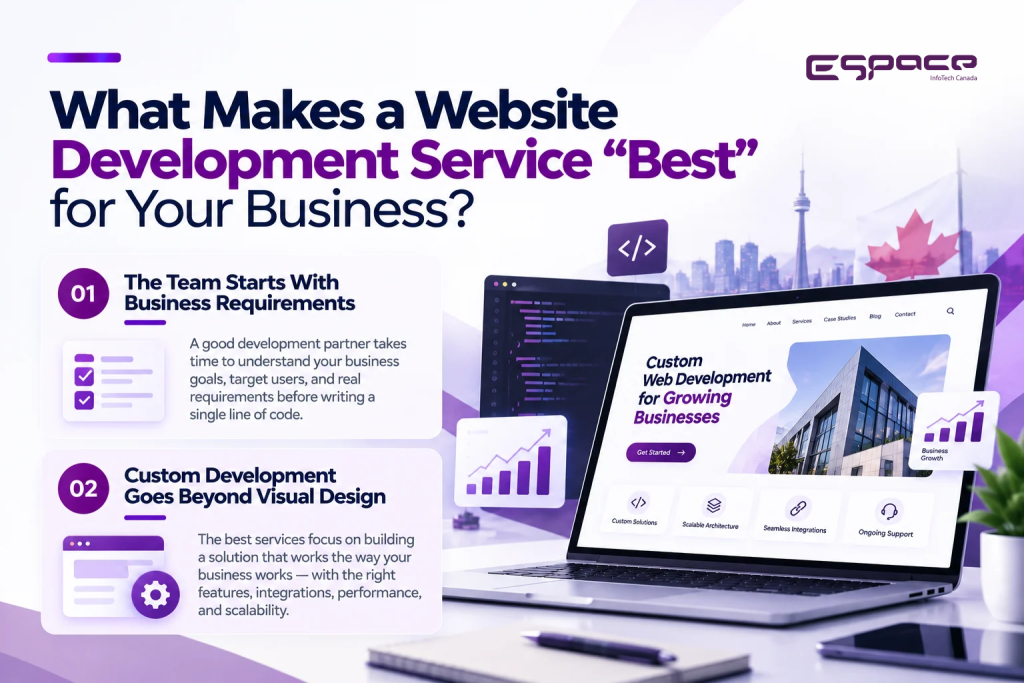
1. The Team Starts With Business Requirements
Good website projects usually begin before anybody starts writing code.
The development team should first understand what users need to accomplish, what the business expects from the website, what systems need to connect, and what success will look like.
For example, a service company may need its website to qualify leads before they reach sales. A distributor might need ERP or inventory integration. A SaaS company may require its marketing website to work closely with product onboarding and analytics.
The technical architecture should follow these requirements rather than the other way around.
2. Custom Development Goes Beyond Visual Design
Design matters. So does everything underneath it.
A professional website development company in Canada should consider page structure, reusable components, database requirements, integrations, hosting, security, testing, scalability, and maintainability alongside the visual interface.
A website that looks impressive but is difficult to manage can become expensive surprisingly quickly.
The better approach is to design both the customer-facing experience and the underlying system for continued use.
Performance Should Be Designed In, Not Added Later
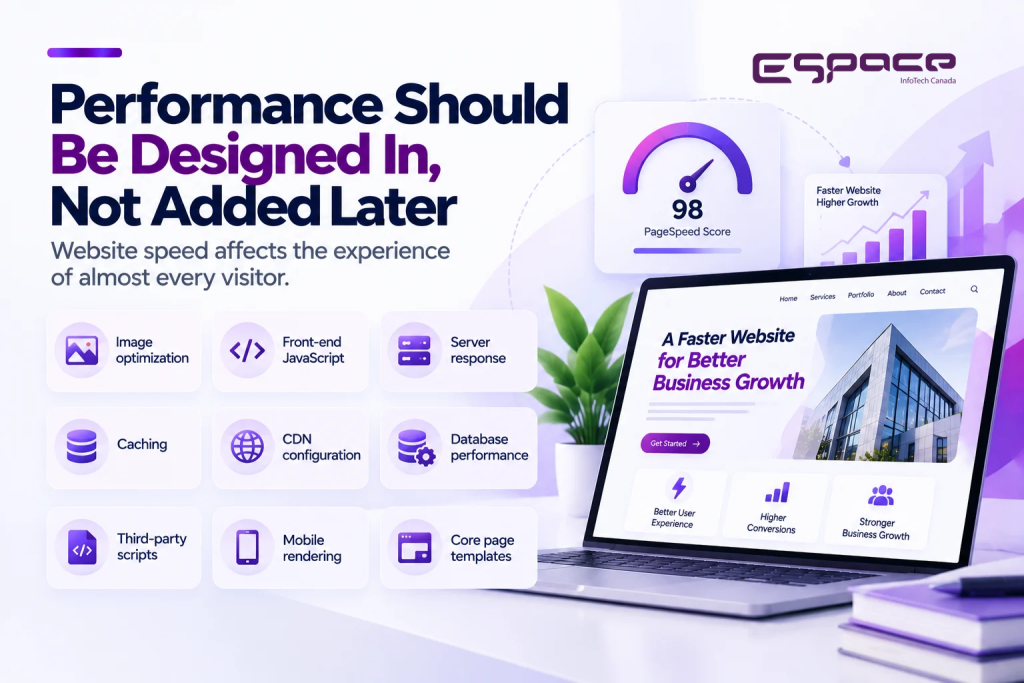
Website speed affects the experience of almost every visitor.
Large images, unnecessary scripts, poorly planned themes, excessive plugins, inefficient code, and slow hosting can turn a visually appealing website into a frustrating one.
Performance planning should therefore begin during development.
A capable custom development team may review:
- Image optimization
- Front-end JavaScript
- Server response
- Caching
- CDN configuration
- Database performance
- Third-party scripts
- Mobile rendering
- Core page templates
Performance work is easier when the website architecture supports it from the beginning.
SEO-Friendly Development Starts With the Website Structure
SEO is not something that should begin after a website launches.
Developers influence many parts of technical SEO, including URL structure, mobile compatibility, page speed, redirects, metadata implementation, crawlability, canonicalization, structured data, and semantic HTML.
Google also uses structured data to better understand page content and potentially support enhanced search appearances.
For a business planning to invest in organic visibility, development and SEO should therefore work together.
An SEO-friendly website development process should give marketers enough flexibility to manage titles, metadata, headings, URLs, images, redirects, internal links, and structured content without requiring code changes for ordinary updates.
Accessibility Matters for Canadian Websites
Accessibility should also be considered during design and development.
Accessible navigation, sufficient colour contrast, keyboard functionality, meaningful labels, text alternatives for images, logical content structure, and usable forms can make websites easier to use for a wider audience.
Accessibility can also be a regulatory consideration depending on the organization and jurisdiction.
For example, Ontario’s accessibility requirements apply to certain organizations and require qualifying public websites and web content to meet specified WCAG criteria.
The practical lesson is simple: accessibility is much easier to implement deliberately during design and development than to repair after a website has already been built.
Security Cannot Be an Afterthought
Business websites frequently interact with contact forms, user accounts, analytics platforms, CRMs, APIs, payment systems, databases, and third-party services.
Every integration increases the importance of secure development practices.
Security planning may include:
- Input validation
- Authentication controls
- Role-based permissions
- Secure API implementation
- Dependency management
- HTTPS configuration
- Backup processes
- Secure deployment
- Monitoring
- Vulnerability testing
Secure-by-design thinking is preferable to discovering avoidable weaknesses after deployment.
For projects involving customer accounts, financial information, healthcare information, or other sensitive data, security requirements should be discussed during architecture planning.
Your Website Should Connect With the Rest of the Business
Modern business websites rarely operate alone.
A custom site can connect with systems such as:
- CRM platforms
- ERP software
- Marketing automation
- Payment gateways
- Inventory systems
- Customer support software
- Appointment scheduling
- Analytics platforms
- Email marketing systems
- Custom business applications
This is where custom development often provides significantly more flexibility than a basic template implementation.
Instead of making employees manually transfer information between systems, integrations can allow information to move through defined workflows.
For businesses considering this type of connected platform, Espace InfoTech Inc. can help evaluate the technical requirements and integration architecture.
Custom Website vs Template Website
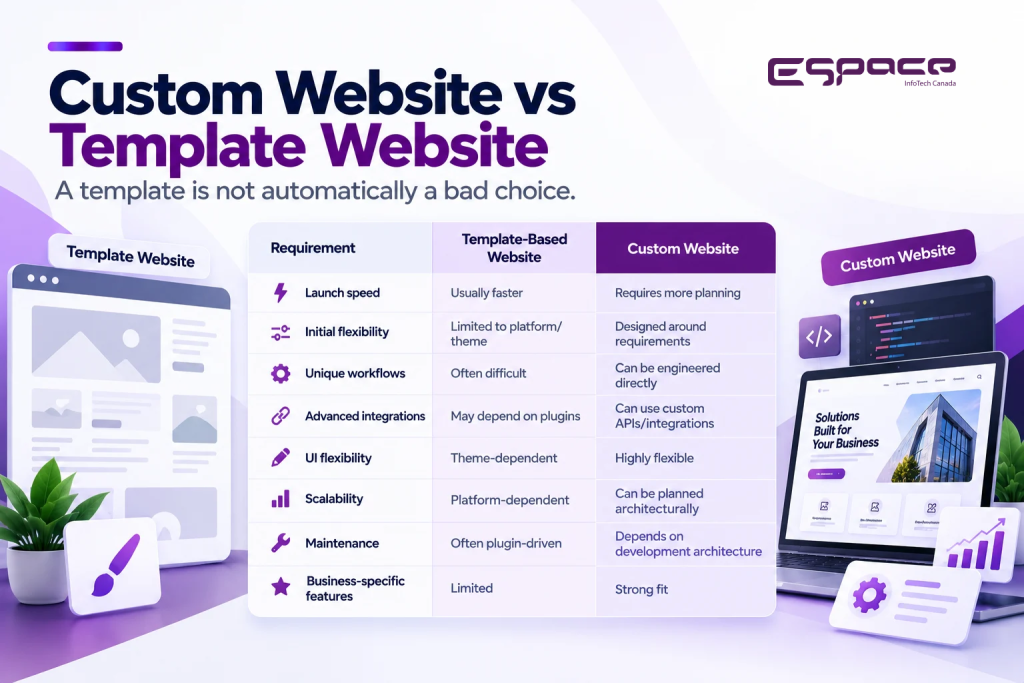
A template is not automatically a bad choice.
For a small informational website with standard requirements, it may be perfectly adequate.
The decision changes when business requirements become more complex.
| Requirement | Template-Based Website | Custom Website |
|---|---|---|
| Launch speed | Usually faster | Requires more planning |
| Initial flexibility | Limited to platform/theme | Designed around requirements |
| Unique workflows | Often difficult | Can be engineered directly |
| Advanced integrations | May depend on plugins | Can use custom APIs/integrations |
| UI flexibility | Theme-dependent | Highly flexible |
| Évolutivité | Platform-dependent | Can be planned architecturally |
| Maintenance | Often plugin-driven | Depends on development architecture |
| Business-specific features | Limité | Strong fit |
The best option depends on the project.
A reputable development company should be willing to say when custom development is unnecessary rather than recommending a larger project simply because it costs more.
How AI Can Be Used in Modern Business Websites
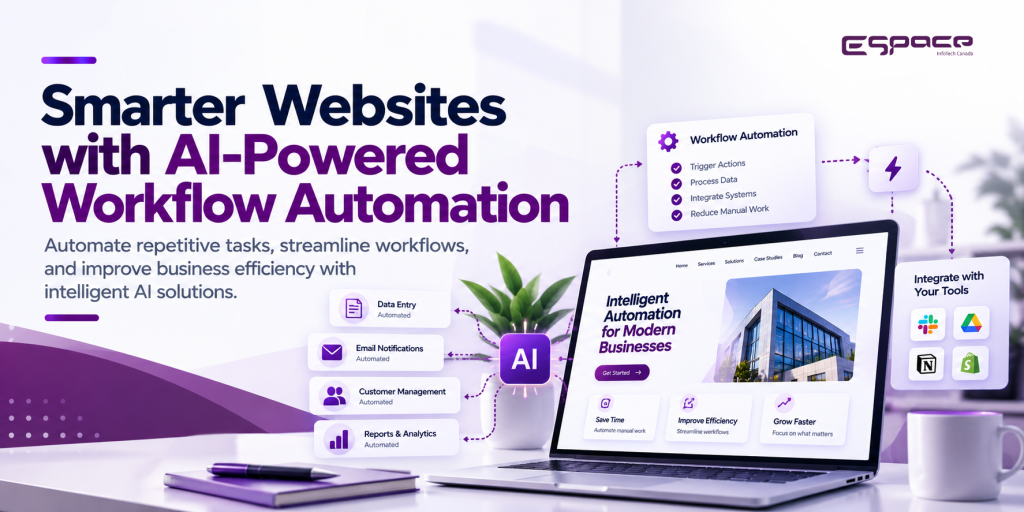
AI does not need to dominate a website to be useful.
Some businesses are beginning to use AI for practical functions such as customer assistance, content discovery, product recommendations, lead qualification, document analysis, internal search, or workflow automation.
For example, a service website might use an AI-supported assistant to understand what a visitor is looking for before directing the enquiry to the appropriate team.
An eCommerce platform might use recommendation logic to help customers discover relevant products.
A customer portal could use AI to summarize account information or help users find answers across large knowledge bases.
The key is to identify a useful business case first. Adding AI simply because it is fashionable rarely improves a website.
Why Businesses Consider Espace InfoTech for Custom Website Development
Espace InfoTech Canada Inc. works across software and web application development, UI/UX, mobile applications, AI development, and related technology services.
That broader engineering capability matters when a website needs to become more than a collection of marketing pages.
A project may eventually require APIs, automation, custom workflows, SaaS functionality, customer dashboards, AI features, or integration with existing applications.
Working with a development team that can handle both website engineering and broader software requirements can reduce the need to rebuild the technical foundation as requirements become more sophisticated.
If your organization is evaluating a custom website development service in Canada, you can discuss the project with Espace InfoTech Inc.
Choosing the Right Custom Website Development Partner
The best website development decision is rarely based on a single feature or technology.
Look for a team that asks good questions before proposing solutions.
Review whether they understand:
- Your customers
- Business workflows
- Conversion goals
- Content requirements
- Technical integrations
- SEO
- Accessibility
- Performance
- Security
- Future functionality
Also pay attention to how clearly the team communicates.
A technically capable provider that cannot explain trade-offs, timelines, assumptions, and risks can make an otherwise promising project unnecessarily difficult.
Conclusion
Finding the best custom website development service in Canada is less about discovering the company with the longest feature list and more about finding the right technical and business fit.
A useful website should be easy for customers to navigate, easy for your team to manage, technically sound, secure, responsive, searchable, and capable of supporting future requirements.
Custom development makes the most sense when the website needs to reflect business-specific processes instead of forcing the organization to work around the limitations of a standard template.
If you are planning a new website, replacing an outdated platform, or considering integrations and custom functionality, contact Espace InfoTech Inc. to discuss the technical approach before development begins.
FAQ
What is custom website development?
Custom website development is the process of designing and building a website around specific business, user, integration, and technical requirements instead of relying entirely on a predefined template.
How much does custom website development cost in Canada?
There is no reliable single price for every custom website. Cost depends on design complexity, number of templates, custom functionality, integrations, content requirements, testing, security needs, and the technology used.
A detailed scope should be prepared before treating any estimate as meaningful.
Is a custom website better than WordPress?
Not automatically.
WordPress can support both template-based and highly customized websites. The important question is whether the architecture, theme, plugins, custom development, hosting, and maintenance approach support the project’s requirements.
How long does a custom website take to develop?
Timelines vary according to scope. A focused corporate website can require substantially less work than an eCommerce platform, customer portal, multilingual site, or website with multiple custom integrations.
Discovery and requirements should come before a reliable delivery estimate.
Should SEO be included during website development?
Yes. Technical SEO decisions such as URL structure, crawlability, redirects, structured content, mobile performance, semantic HTML, and metadata capabilities are influenced by development.
Can a custom website integrate with CRM or ERP software?
Yes. APIs and custom integrations can connect websites with CRMs, ERP platforms, payment systems, marketing software, inventory tools, and other business applications when the systems provide appropriate integration capabilities.
Do Canadian business websites need to be accessible?
Accessibility obligations depend on factors such as jurisdiction and type or size of organization. Even where a specific requirement does not apply, following recognized accessibility practices can make a website usable by a broader audience.