

Cloud Migration Services in Canada: A Complete Guide for Businesses in 2026
For many Canadian businesses, maintaining legacy servers and outdated applications can make technology increasingly difficult to manage. Infrastructure becomes harder to scale, software updates take longer, and supporting older systems can require significant technical resources.
C'est ici qu'entrent cloud migration services can help. Moving applications, databases, servers, and other workloads to a cloud environment can give businesses greater flexibility while creating opportunities to modernize their technology.
However, cloud migration is not simply about moving everything from an on-premise server to AWS or Azure. A successful migration requires planning, security assessment, application analysis, testing, and a clear understanding of business requirements.
For Canadian businesses considering a move to the cloud, understanding the process and available strategies is an important first step.
What Are Cloud Migration Services?
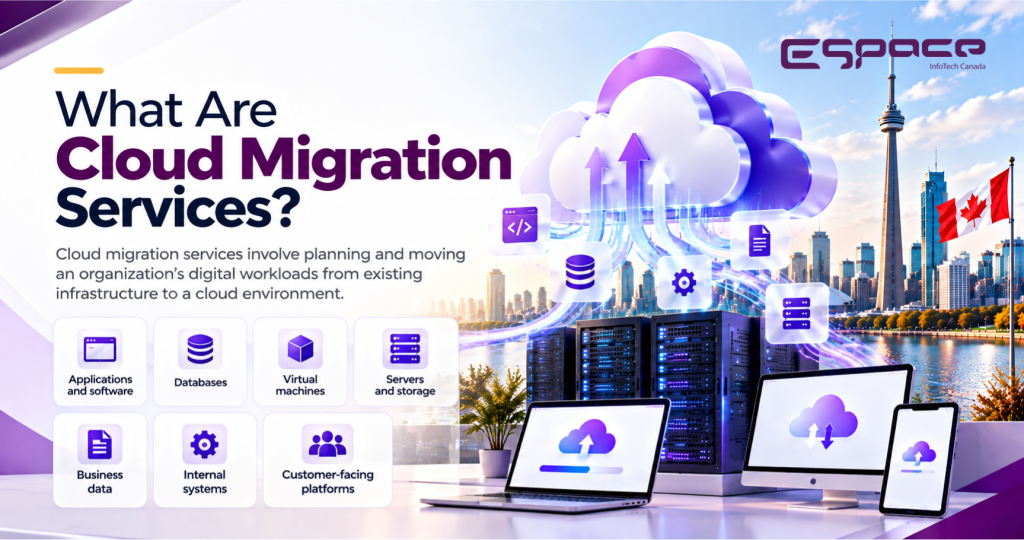
Cloud migration services involve planning and moving an organization’s digital workloads from existing infrastructure to a cloud environment.
Depending on the business, this may include:
- Applications and software
- Databases
- Virtual machines
- Servers and storage
- Business data
- Internal systems
- Customer-facing platforms
The goal is not necessarily to move everything at once. Some applications may be migrated with minimal changes, while others may need to be modernized or replaced.
AWS identifies seven common migration strategies, known as the 7 Rs: rehost, relocate, repurchase, replatform, refactor, retain, and retire. Microsoft Azure similarly recommends selecting a migration strategy based on business drivers, technical requirements, security, compliance, and application complexity.
Why Are Canadian Businesses Moving to the Cloud?
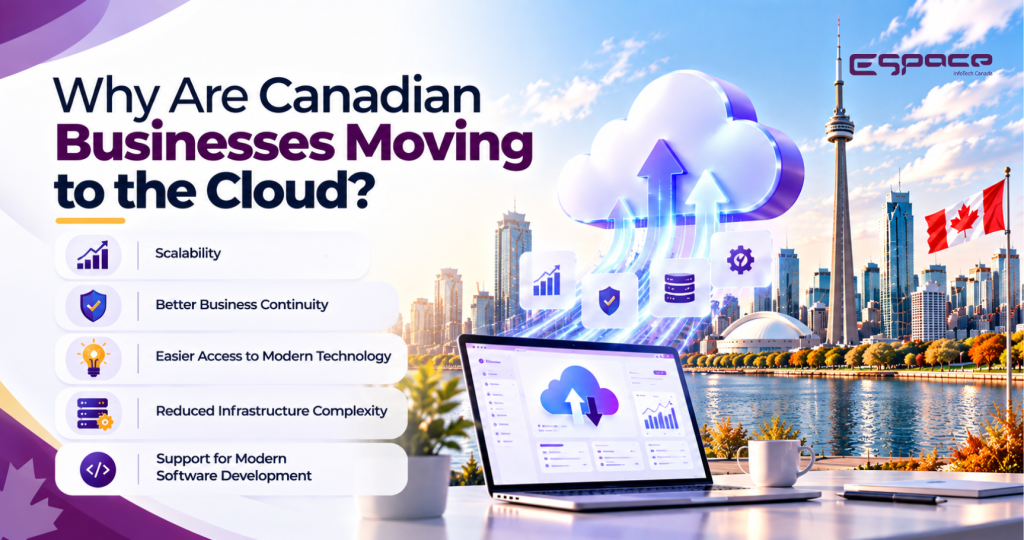
Cloud adoption can provide businesses with more flexible infrastructure and access to services that can be difficult or expensive to build and maintain internally.
The Canadian Centre for Cyber Security notes that cloud services can provide flexibility, scalability, and on-demand computing, while also emphasizing that organizations remain responsible for protecting their information and IT services.
Some common reasons businesses consider cloud migration include:
Évolutivité
Traditional infrastructure may require businesses to purchase additional hardware when demand increases. Cloud environments can provide more flexible access to computing, storage, and other resources.
Better Business Continuity
Cloud environments can support backup, recovery, and availability strategies that help businesses prepare for infrastructure failures and other disruptions.
Easier Access to Modern Technology
Cloud platforms provide access to managed databases, analytics, AI services, monitoring tools, security services, and other technologies without requiring every component to be built internally.
Reduced Infrastructure Complexity
Moving appropriate workloads to managed cloud services can reduce the amount of physical infrastructure a business needs to operate and maintain.
Support for Modern Software Development
Cloud infrastructure works well with modern development practices such as DevOps, automated deployment, containers, and continuous integration and delivery.
Cloud Migration vs. Cloud Modernization: What's the Difference?
These terms are often used together, but they are not exactly the same.
Cloud migration generally means moving an existing workload into a cloud environment.
Cloud modernization goes further by changing an application’s architecture, infrastructure, or components so that it can take better advantage of cloud capabilities.
For example, a company could move an older application to a cloud server without changing its architecture. That is migration.
Another company might break a large legacy application into modern services, move databases to managed cloud infrastructure, introduce automated deployment, and redesign parts of the application. That is modernization.
The right approach depends on the application’s condition, business importance, technical complexity, and long-term goals.
Common Cloud Migration Strategies for Canadian Businesses
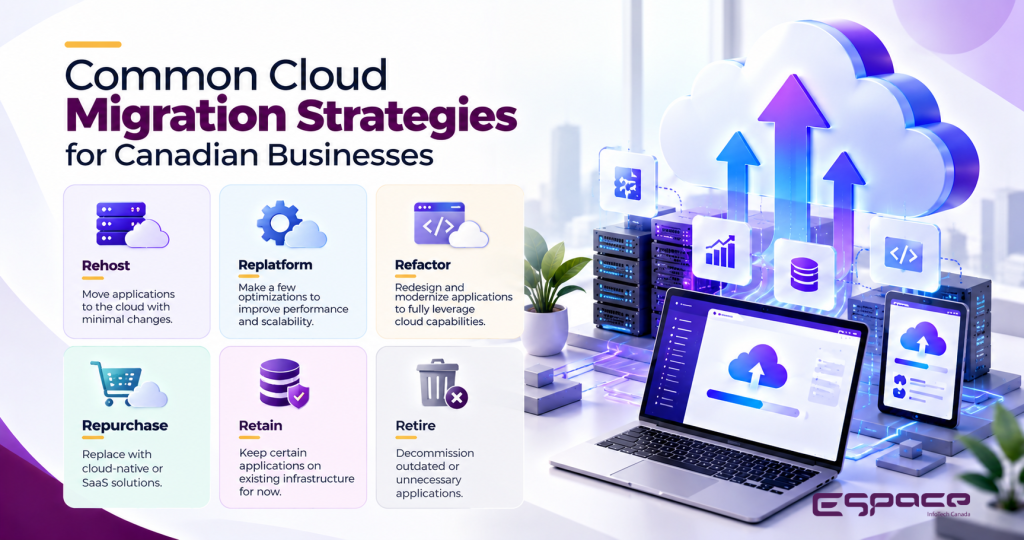
There is no single migration strategy that works for every application.
Rehost
Often called “lift and shift,” rehosting moves an application to the cloud with minimal changes. It can be useful when a business wants to reduce infrastructure dependency without immediately redesigning an application.
Replatform
Replatforming involves making selected improvements without completely redesigning the application. For example, an application might move to a managed database service.
Refactor
Refactoring involves changing the application’s code or architecture to take better advantage of cloud capabilities. This can provide greater long-term benefits but generally requires more planning and development effort.
Repurchase
A business may replace an existing system with a cloud-based software solution rather than migrating the existing application.
Retain
Some applications may not be suitable for immediate migration. Keeping them where they are can be appropriate until the business has a stronger reason or better opportunity to move them.
Retire
If an application no longer provides meaningful business value, retiring it may make more sense than spending resources migrating it.
AWS and Microsoft both emphasize assessing workloads individually rather than applying the same migration strategy to every system.
AWS vs. Microsoft Azure for Canadian Businesses
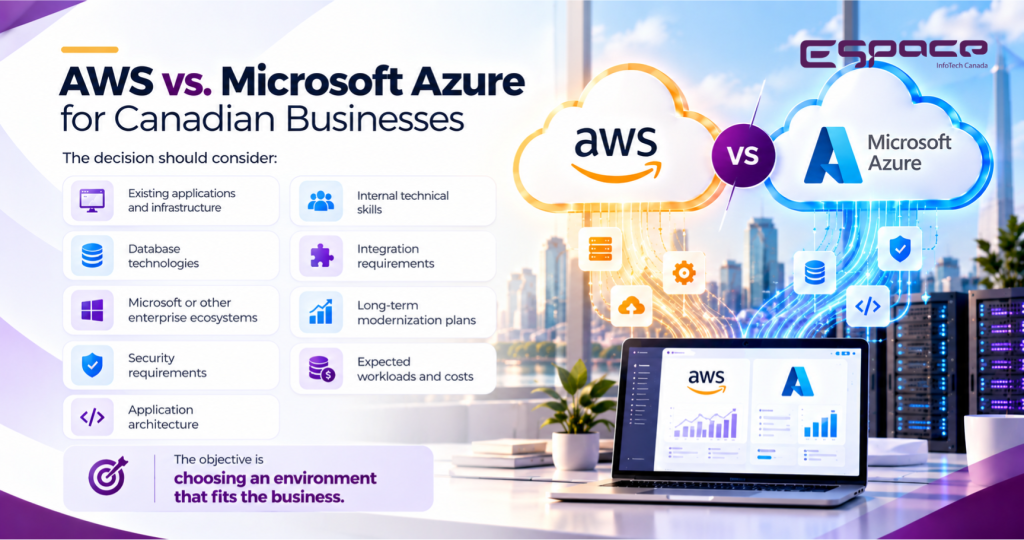
Two of the major cloud platforms businesses may consider are AWS des commandes Microsoft Azure.
Both provide infrastructure, databases, storage, security capabilities, analytics, AI services, monitoring, and other cloud technologies. The right choice depends on the organization’s existing technology environment and business requirements.
For example, a business heavily invested in Microsoft’s ecosystem may have specific reasons to consider Azure. Another organization may have an existing AWS environment or application architecture that makes AWS a practical choice.
The decision should consider:
- Existing applications and infrastructure
- Database technologies
- Microsoft or other enterprise ecosystems
- Security requirements
- Application architecture
- Internal technical skills
- Integration requirements
- Long-term modernization plans
- Expected workloads and costs
The objective should not be choosing a cloud provider simply because it is popular. The objective is choosing an environment that fits the business.
How Does the Cloud Migration Process Work?
A successful cloud migration usually starts well before anything is moved.
1. Cloud Readiness Assessment
The first step is understanding the existing environment. Teams should review applications, servers, databases, dependencies, integrations, security requirements, and performance.
A detailed application inventory can help determine which systems should be migrated, modernized, retained, replaced, or retired. AWS also recommends evaluating application dependencies and technical complexity when developing migration plans.
2. Migration Planning
The next step is developing the target architecture and deciding how individual workloads will be migrated.
This includes defining migration priorities, dependencies, risks, testing requirements, timelines, and rollback plans.
3. Pilot Migration
Rather than moving critical systems immediately, businesses can begin with a lower-risk workload. This provides an opportunity to validate the architecture and identify problems before larger migration waves begin.
4. Application and Data Migration
Once the strategy has been validated, applications and data can be migrated in controlled stages.
5. Testing
Applications should be tested for performance, functionality, security, integrations, availability, and user access before production use.
6. Optimization
Migration should not necessarily be considered finished when the application is running in the cloud. Businesses should continue monitoring infrastructure usage, security, performance, and costs.
Best Practices for Data Security During Cloud Migration
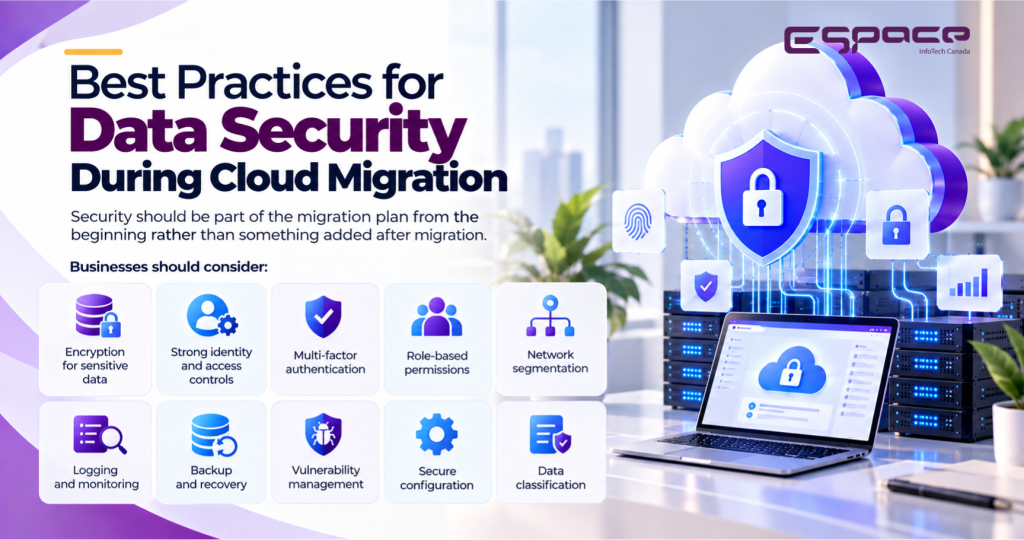
Security should be part of the migration plan from the beginning rather than something added after migration.
The Canadian Centre for Cyber Security emphasizes that organizations remain accountable for protecting the confidentiality, integrity, and availability of their information even when cloud services are used. It also highlights the importance of understanding privacy obligations, including PIPEDA, provincial privacy laws, and sector-specific requirements where applicable.
Businesses should consider:
- Encryption for sensitive data
- Strong identity and access controls
- Multi-factor authentication
- Role-based permissions
- Network segmentation
- Logging and monitoring
- Backup and recovery
- Vulnerability management
- Secure configuration
- Data classification
Canadian organizations should also evaluate applicable privacy and regulatory requirements based on their industry, the type of information they process, and where that information is stored or accessed.
How Much Do Cloud Migration Services Cost in Canada?
There is no single price for cloud migration services in Canada because every migration has different requirements.
The overall cost can depend on:
- Number of applications
- Data volume
- Infrastructure size
- Application complexity
- Legacy technology
- Required integrations
- Migration strategy
- Security requirements
- Cloud platform
- Modernization requirements
- Post-migration support
It is also important to separate migration cost from ongoing cloud cost.
A business may spend money on assessment, architecture, development, testing, and migration initially. Afterward, it must manage cloud infrastructure, software licenses, monitoring, security, backups, and optimization.
A proper assessment can provide a much more useful estimate than choosing a migration package based only on infrastructure size.
Conclusion
Cloud migration services in Canada can help businesses move away from aging infrastructure while creating a foundation for scalability, modernization, security, and faster software delivery.
But successful migration is not simply about moving servers to the cloud. Businesses need to understand their existing applications, identify dependencies, choose the right migration strategy, protect their data, and plan for what happens after migration.
For some workloads, rehosting may be enough. Others may benefit from replatforming or full modernization. Some applications may be better retained or retired.
The right strategy is therefore the one that connects technology decisions with business goals.
If your organization is evaluating its cloud readiness or planning a migration, Espace InfoTech Inc. can help assess existing applications, identify migration opportunities, and develop a practical roadmap for cloud migration and modernization.