

Cloud School Management Software: Why Schools Are Moving Away From Traditional Systems
Schools today manage more than just classrooms and student records. They handle admissions, attendance, fees, exams, communication, staff management, parent engagement, and daily administrative operations. For many institutions, traditional systems based on spreadsheets, paper records, and disconnected software tools are becoming difficult to manage. As schools grow, they need better visibility, faster communication, and more efficient workflows. This is why cloud school management software is becoming a preferred solution for modern educational institutions. By moving school operations to a secure cloud-based platform, schools can centralize their data, automate repetitive tasks, and create a better experience for administrators, teachers, students, and parents.
Why Traditional School Management Systems Are Becoming Challenging
Traditional school management approaches often require manual data entry, physical documents, and multiple systems for different activities. While these methods may work for smaller institutions, they create challenges as schools expand. Common problems include:
- Student information stored in multiple places
- Time-consuming administrative tasks
- Delayed communication with parents
- Manual attendance tracking
- Difficulty managing fees and reports
- Limited access to real-time information
- Increased risk of data errors
School administrators need more than record-keeping. They need a connected system that helps them make faster and better decisions.
What Is Cloud School Management Software?
Cloud school management software is a digital platform that allows schools to manage academic and administrative activities through a centralized online system. Unlike traditional systems installed on individual computers, cloud-based solutions allow authorized users to securely access information anytime and from anywhere. A modern school management platform can include:
- Student information management
- Online admission management
- Attendance tracking
- Fee and payment management
- Examination management
- Teacher and staff management
- Parent communication
- Digital reports and analytics
- Learning management features
- Automated notifications
The goal is to reduce manual work and improve operational efficiency.
Key Benefits of Cloud School Management Software
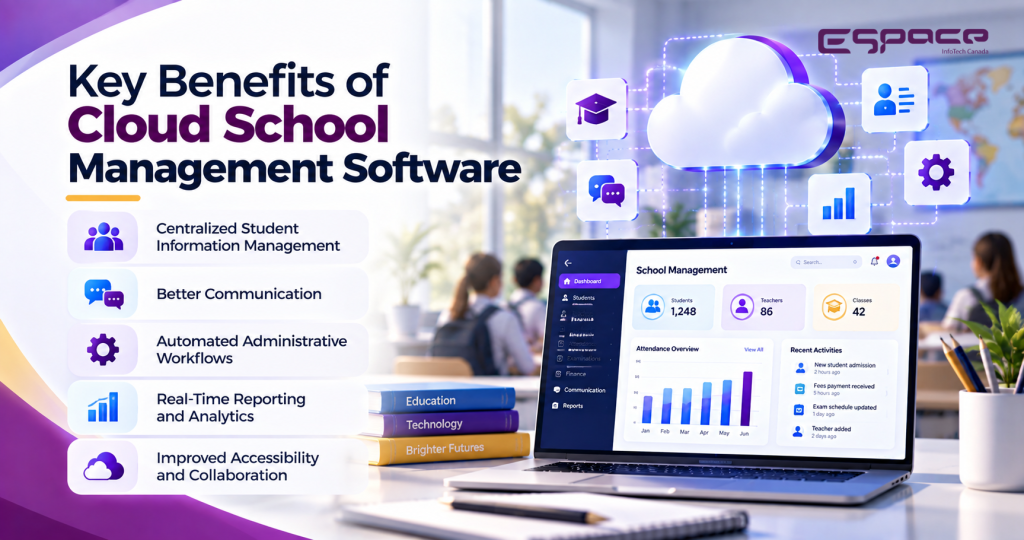
1. Centralized Student Information Management
Schools handle large amounts of student data every day. A cloud-based system keeps important information organized in one place, including:
- Student profiles
- Academic records
- Attendance history
- Examination results
- Fee information
- Parent details
This allows administrators and teachers to access accurate information quickly without searching through multiple files.
2. Better Communication Between Schools and Parents
Communication is one of the biggest challenges in education management. Parents want regular updates about attendance, assignments, fees, exams, and school activities. Cloud school management software can improve communication through:
- Automated notifications
- Parent portals
- Mobile access
- Digital announcements
- Attendance alerts
- Result sharing
Better communication creates stronger relationships between schools and families.
3. Automated Administrative Workflows
Many school activities require repetitive manual tasks. Automation can help reduce workload by managing:
- Fee reminders
- Attendance reports
- Exam schedules
- Student records
- Certificates
- Notifications
- Administrative reports
This allows school staff to spend more time focusing on students instead of paperwork.
4. Real-Time Reporting and Analytics
School leaders need accurate information to make decisions. A cloud-based system can provide dashboards and reports for:
- Student performance
- Attendance trends
- Fee collection
- Teacher workload
- Enrollment analysis
- Operational performance
With better visibility, administrators can identify problems earlier and improve planning.
5. Improved Accessibility and Collaboration
Because cloud platforms are accessible online, teachers, administrators, and parents can access required information based on their roles. For example: Teachers can update attendance and academic records. Parents can check student progress and notifications. Administrators can monitor overall operations. This creates better collaboration across the entire education ecosystem.
Security and Data Protection in Cloud School Systems
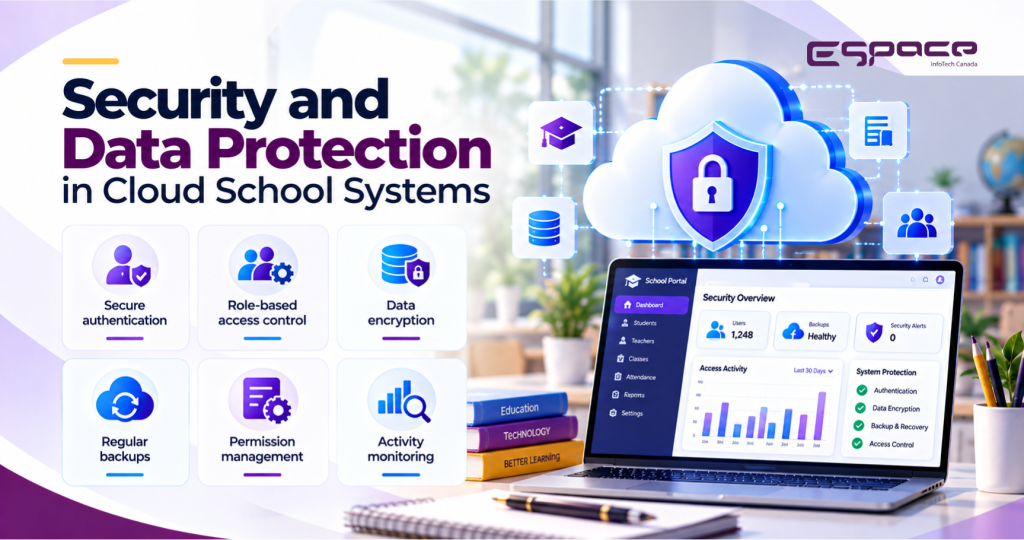
Schools manage sensitive information, including student records, family details, financial information, and academic performance. A reliable cloud school management system should include:
- Secure authentication
- Un contrôle d’accès fondé sur les rôles
- Data encryption
- Regular backups
- Permission management
- Activity monitoring
Security should be considered from the beginning when selecting or developing an education management platform.
AI Implementation in School Management Software
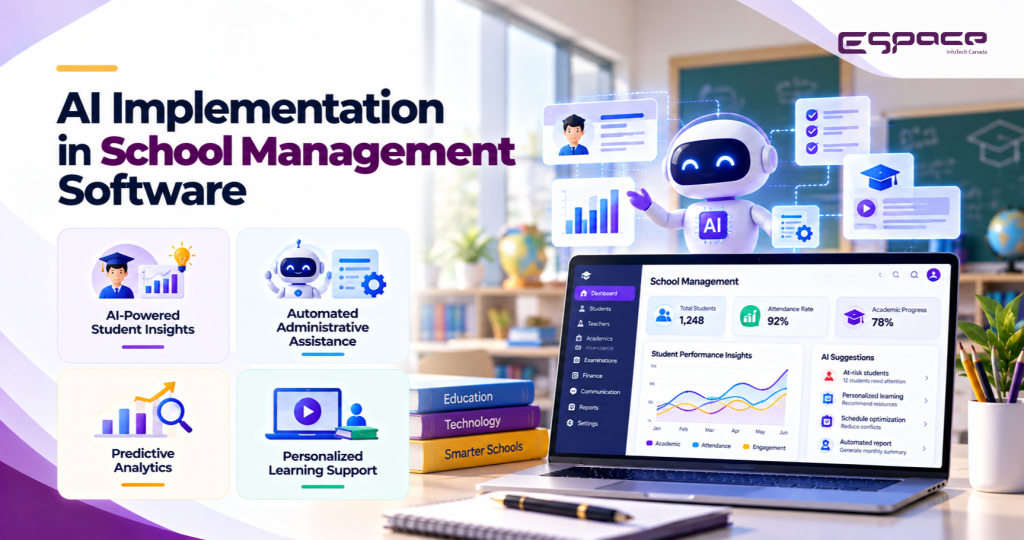
Artificial intelligence can make school management platforms smarter and more efficient. AI can support schools through:
AI-Powered Student Insights
AI can analyze attendance patterns, academic performance, and learning behaviour to identify students who may need additional support.
Automated Administrative Assistance
AI assistants can help answer common questions from parents, students, and staff regarding schedules, fees, policies, and general information.
Predictive Analytics
AI can help schools identify trends related to enrollment, attendance, student performance, and resource planning.
Personalized Learning Support
AI-powered systems can recommend learning resources based on student performance and learning needs. However, AI should support teachers and administrators, not replace human decision-making. Education requires empathy, understanding, and personal interaction.
Why Schools Are Choosing Cloud-Based Education Platforms
The shift toward cloud school management software is not only about technology. It is about creating a more connected, efficient, and student-focused education environment. Schools are adopting cloud solutions because they provide:
- Faster access to information
- Reduced administrative workload
- Better communication
- Improved decision-making
- Easier scalability
- More organized operations
As educational needs continue to evolve, digital transformation is becoming essential for institutions that want to provide better experiences.
Why Custom School Management Software Can Be Valuable
Every educational institution has different workflows, policies, and requirements. A standard solution may not always fit schools with unique needs. Custom school management software allows institutions to build features based on their specific processes, such as:
- Custom admission workflows
- Unique reporting requirements
- Parent and student portals
- Integration with payment systems
- Learning management features
- Applications mobiles
- AI-powered automation
A customized platform provides more flexibility, control, and scalability.
Conclusion
Traditional school management systems are becoming difficult to maintain as educational institutions grow. Cloud school management software provides a smarter way to manage student information, automate operations, improve communication, and support better decision-making. The future of education management is not only digital. It is connected, automated, and focused on creating better experiences for students, teachers, and parents. Espace Infotech Canada Inc. can help schools build secure cloud-based education platforms with automation, analytics, AI capabilities, and modern digital experiences.
FAQ
What is cloud school management software?
Cloud school management software is an online platform that helps schools manage student records, attendance, fees, communication, academics, and administrative operations.
Why are schools moving to cloud-based systems?
Schools are adopting cloud systems because they provide better accessibility, automation, communication, security, and real-time reporting.
Is cloud school management software secure?
Yes, when properly developed, cloud school systems can use encryption, authentication, backups, and access controls to protect sensitive information.
Can AI be added to school management software?
Yes. AI can support student insights, automated assistance, predictive analytics, and personalized learning recommendations.
Can Espace Infotech Canada build custom school management software?
Yes. Espace Infotech Canada Inc. develops custom education platforms, school ERP systems, portals, automation solutions, and AI-powered software.