Businesses use websites to generate leads, support customers, manage content, connect with other systems, automate workflows, and create better digital experiences.
But when building a website, one important question appears:
Should a business use a ready-made content management system (CMS), or invest in custom website development?
The answer depends on business goals, required features, scalability needs, and future plans.
A CMS can be a practical choice for businesses that need a website quickly with standard features. However, companies with unique workflows, advanced integrations, or long-term growth plans may benefit more from a custom solution.
Understanding the difference between CMS vs Custom Website Development helps businesses choose the right technology approach.
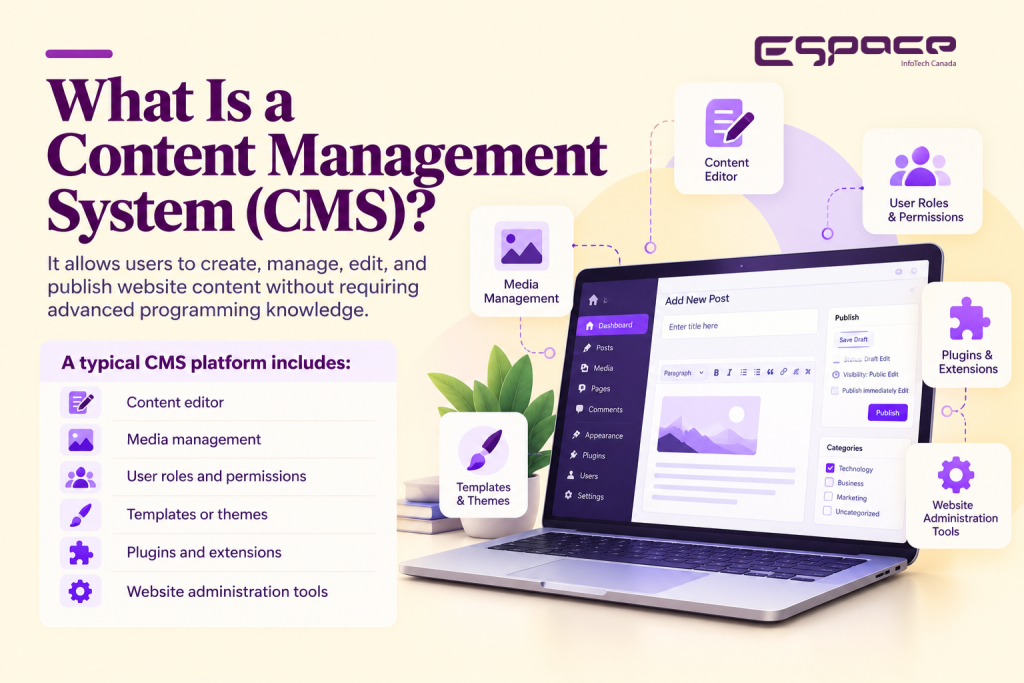
What Is a Content Management System (CMS)?
A content management system is software that allows users to create, manage, edit, and publish website content without requiring advanced programming knowledge.
In web development, a CMS separates content management from technical development. This allows marketing teams and administrators to update website pages, images, blogs, and other content through an admin dashboard.
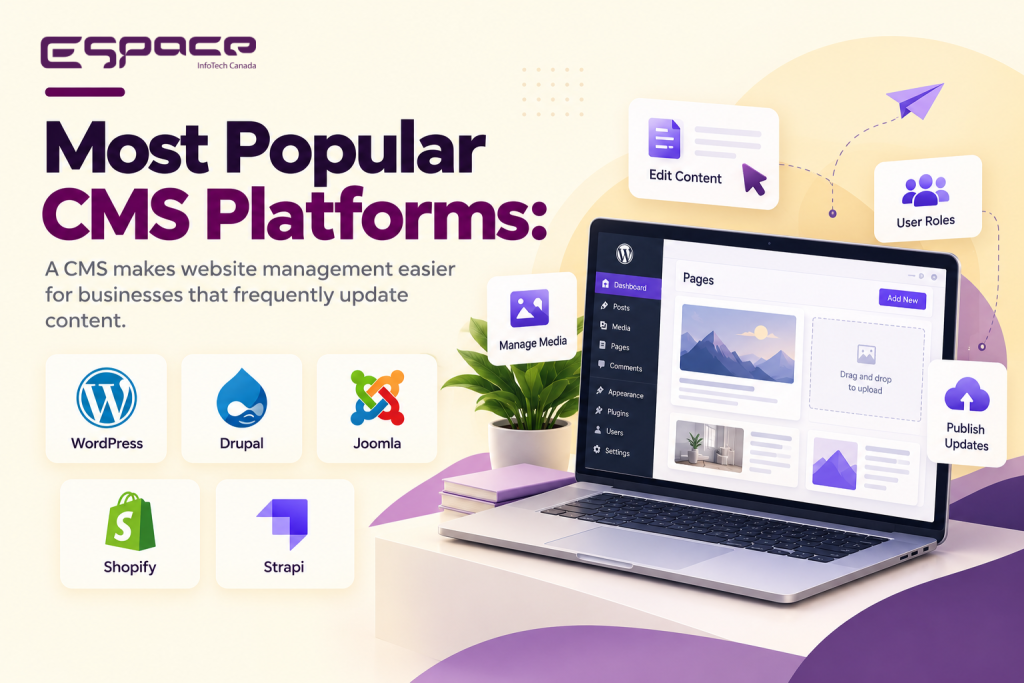
A CMS makes website management easier for businesses that frequently update content.
How Does a CMS Website Work?
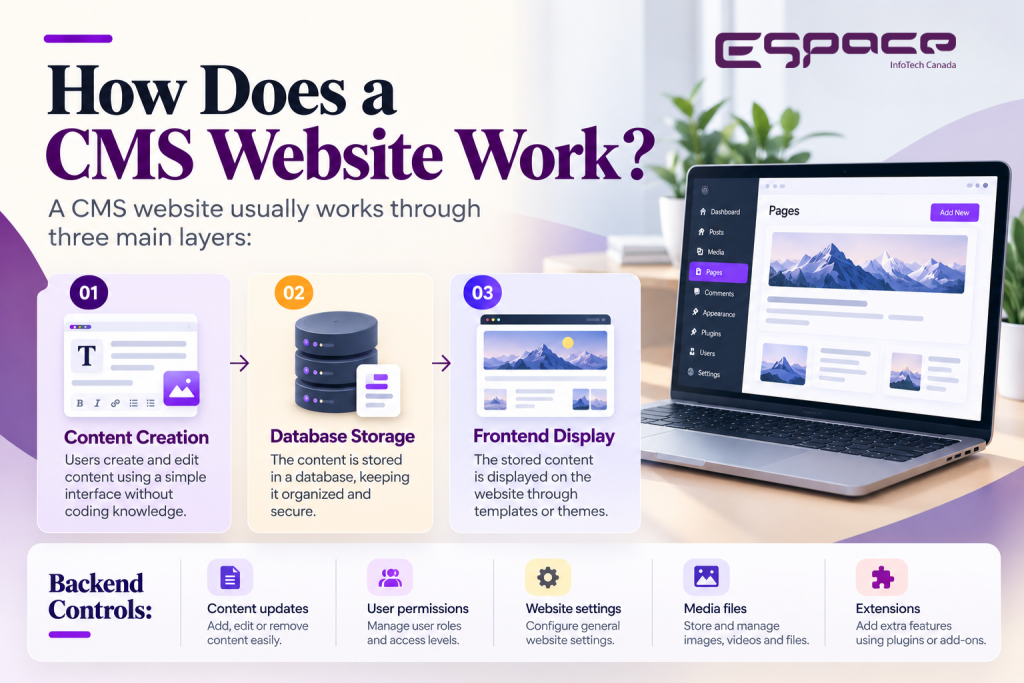
A CMS website usually works through three main layers:
1. Content Creation
Users create content such as pages, blogs, images, products, or announcements through the CMS dashboard.
2. Database Storage
The CMS stores content, user information, settings, and website configurations in a database.
3. Frontend Display
The website frontend displays the stored content using themes, templates, and design components.
The CMS backend controls:
Content updates
User permissions
Website settings
Media files
Extensions
The frontend controls what visitors see.
Popular Types of Content Management Systems
CMS Type
Examples
Convient le mieux à
Open Source CMS
WordPress, Drupal, Joomla
Blogs, business websites, communities
E-commerce CMS
Shopify, WooCommerce, Magento
Online stores
Headless CMS
Strapi, Contentful
Modern web applications
Enterprise CMS
Adobe Experience Manager, Sitecore
Large organizations
Different businesses choose different CMS platforms depending on their technical requirements.
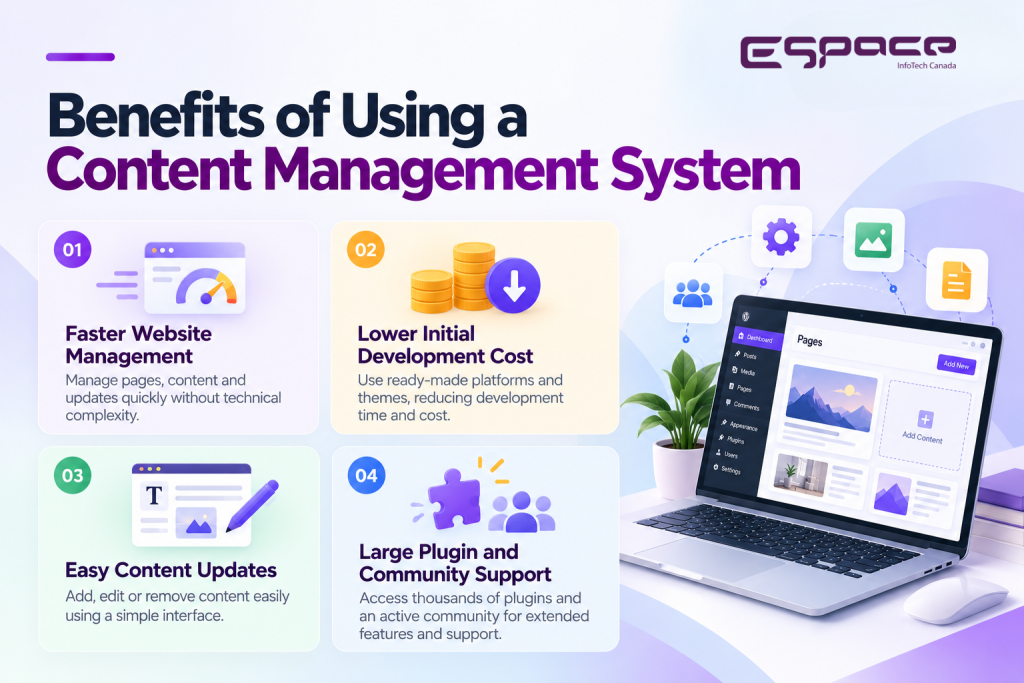
Benefits of Using a Content Management System
1. Faster Website Management
One of the biggest content management system benefits is easy content updates.
Marketing teams can update pages, publish blogs, and manage media without depending on developers for every change.
2. Lower Initial Development Cost
CMS website development usually requires less time compared to building a fully custom platform.
Pre-built themes, plugins, and extensions can reduce initial development effort.
3. Easy Content Updates
Businesses that publish frequent content can benefit from CMS platforms.
Examples include:
Blog publishing
News updates
Product updates
Landing pages
4. Large Plugin and Community Support
Open source content management systems have large developer communities.
Businesses can access thousands of plugins, integrations, themes, and extensions.
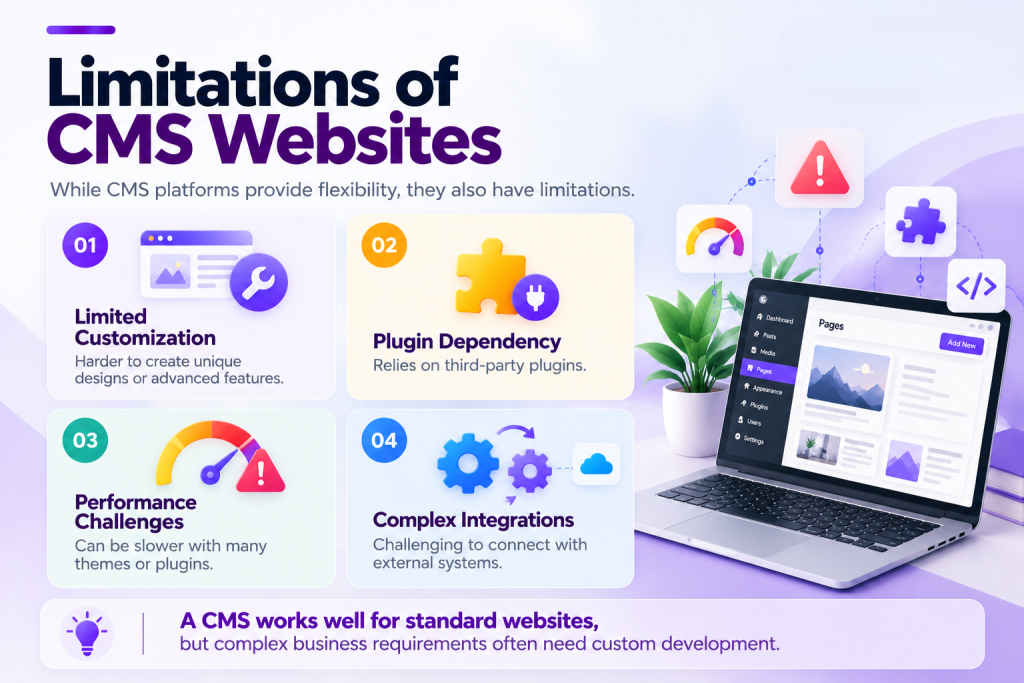
Limitations of CMS Websites
While CMS platforms provide flexibility, they also have limitations.
Limited Customization
A standard CMS follows a predefined structure. Complex business workflows may require significant customization.
Plugin Dependency
Many CMS websites depend on third-party plugins. Poorly maintained plugins can create performance or security issues.
Performance Challenges
Large numbers of plugins, heavy themes, or poor optimization can slow down websites.
Complex Integrations
Businesses requiring advanced CRM, ERP, automation, or internal system connections may find standard CMS platforms limiting.
A CMS works well for standard websites, but complex business requirements often need custom development.
What Is Custom Website Development?
Custom website development means creating a website specifically around a business’s unique requirements.
Instead of adapting existing templates, developers build custom frontend designs, backend systems, workflows, and integrations.
Custom websites can include:
Portails clients
Booking platforms
SaaS applications
ERP-connected websites
CRM-integrated platforms
Marketplace systems
Custom development gives businesses complete control over functionality and user experience.
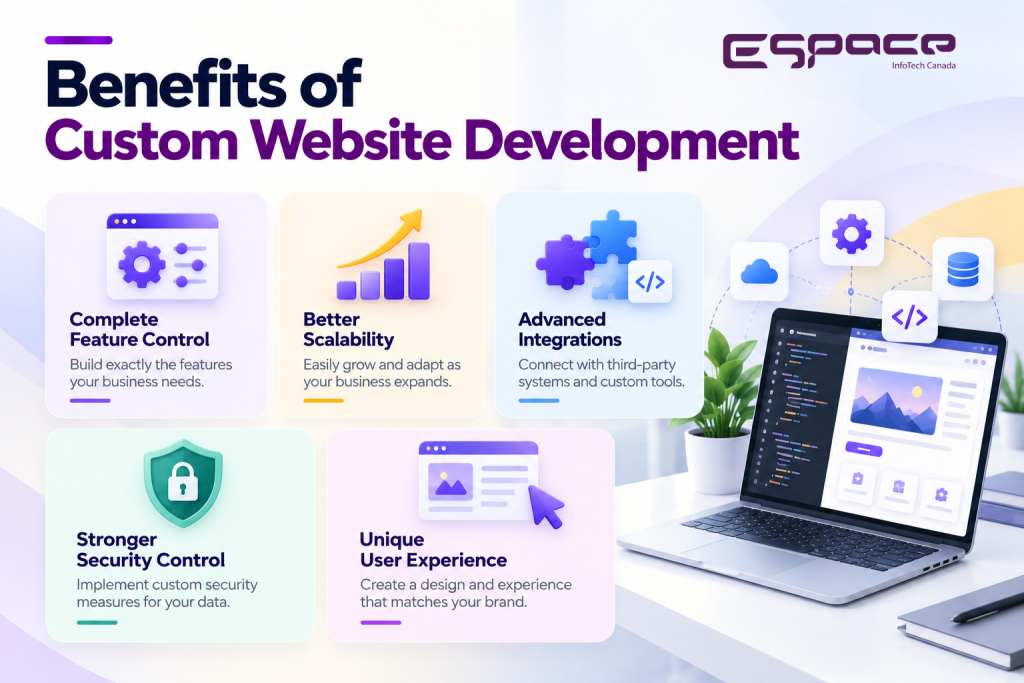
Benefits of Custom Website Development
1. Complete Feature Control
Businesses can build exactly what they need without being restricted by CMS limitations.
2. Better Scalability
Custom solutions can be designed to support future growth, increasing users, transactions, and business complexity.
3. Advanced Integrations
Custom websites can connect with:
CRM systems
ERP platforms
Payment gateways
APIs
Internal business tools
4. Stronger Security Control
Custom security architecture allows businesses to design access control, data protection, and system monitoring according to their needs.
5. Unique User Experience
A custom website can be designed around the complete customer journey instead of following generic templates.
CMS vs Custom Website Development: Key Differences
Facteur
CMS Website
Custom Website
Development Speed
Faster
Longer
Initial Cost
Plus faible
Plus élevé
Customization
Limité
Extensive
Évolutivité
Depends on platform
Highly scalable
Security
Plugin dependent
Custom security approach
Maintenance
Easier initially
Requires technical support
Convient le mieux à
Standard websites
Unique business requirements
CMS vs Custom Website Development: Which One Should Your Business Choose?
Choose CMS If:
A CMS may be the right choice if:
You need a simple website
You publish regular content
Your requirements are standard
Speed and budget are priorities
Examples:
Corporate websites
Blogs
Basic service websites
Choose Custom Website Development If:
Custom development is better when:
Your workflows are unique
You need automation
You require integrations
You need customer portals
You plan long-term scalability
Examples:
Healthcare platforms
SaaS products
Marketplaces
Enterprise applications
Conclusion
There is no universal winner in the debate of CMS vs Custom Website Development.
A CMS is a practical choice for businesses that need a fast, manageable website with standard requirements.
Custom development is better for companies that need flexibility, automation, advanced integrations, and long-term scalability.
The right choice depends on your business goals, technical requirements, and future growth plans.
Need help deciding between CMS and custom website development? Espace InfoTech Inc Canada can analyze your requirements and recommend the right approach.
FAQ
What is a content management system?
A content management system is software that allows users to create, manage, and update website content without extensive coding knowledge.
Is CMS better than custom website development?
It depends on business needs. CMS works well for standard websites, while custom development is better for complex requirements.
What are the benefits of a content management system?
CMS benefits include faster updates, lower initial cost, easier content management, and access to plugins and extensions.
How much does a CMS website cost?
CMS website cost depends on the platform, design, hosting, plugins, and customization requirements.
When should a business choose custom website development?
Businesses should consider custom development when they need unique features, automation, integrations, or scalable solutions.