Software development is getting faster. Teams are using cloud platforms, automation, CI/CD pipelines, containers, APIs, and modern development tools to release applications more frequently.
But faster development also creates a challenge: security cannot remain a final step before deployment.
This is where the difference between DevSecOps vs DevOps becomes important.
DevOps brings development and operations teams together to improve collaboration, automation, deployment speed, and application reliability. DevSecOps takes that approach further by making security part of the development and operations lifecycle.
Instead of discovering security problems just before launch, teams can identify and address risks much earlier.
For businesses building modern applications, this can mean fewer security surprises, faster remediation, and a stronger software development process.
What Is DevOps?
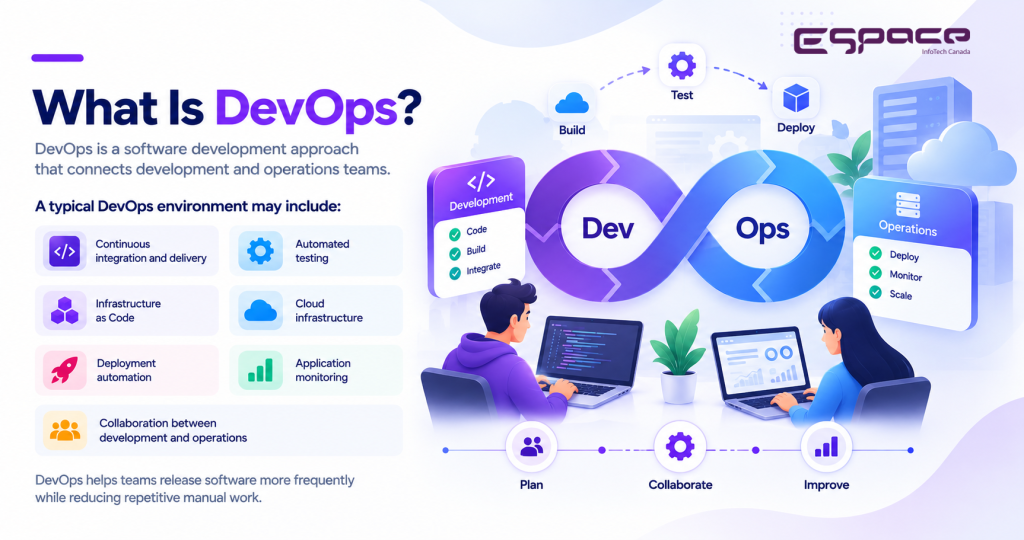
DevOps is a software development approach that connects development and operations teams.
The goal is to make software delivery faster, more reliable, and more consistent through collaboration and automation.
A typical DevOps environment may include:
Continuous integration and delivery
Automated testing
Infrastructure as Code
Cloud infrastructure
Deployment automation
Application monitoring
Collaboration between development and operations
DevOps helps teams release software more frequently while reducing repetitive manual work.
However, security may still be treated as a separate responsibility if it is not deliberately integrated into the process.
What Is DevSecOps?
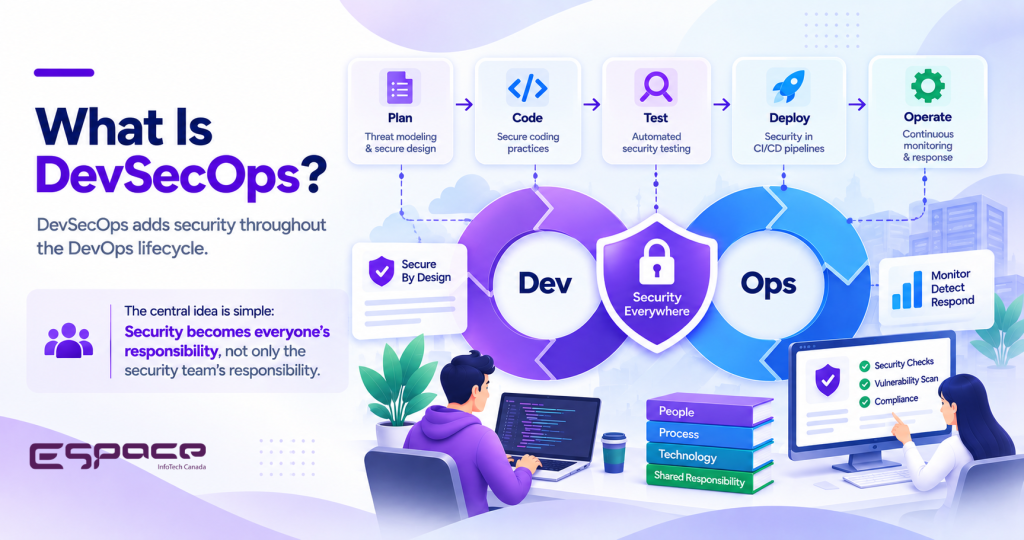
DevSecOps adds security throughout the DevOps lifecycle.
Instead of waiting for a security review near the end of development, security practices are introduced during planning, coding, testing, deployment, and ongoing operations.
This approach can include automated vulnerability scanning, dependency checks, secure coding practices, access control, secrets management, infrastructure security checks, and continuous monitoring.
The central idea is simple:
Security becomes everyone’s responsibility, not only the security team’s responsibility.
DevSecOps vs DevOps: What Is the Difference?
The main difference is where security fits into the development process.
Area
DevOps
DevSecOps
Development
Collaborative and automated
Collaborative, automated, and security-aware
Security
May be handled separately
Integrated throughout the lifecycle
Testing
Focuses on functionality and reliability
Includes security testing
Deployment
Automated through CI/CD
Automated with security controls
Monitoring
Performance and availability
Performance, availability, and security
Responsibility
Development + Operations
Development + Security + Operations
DevSecOps does not replace DevOps. It extends the DevOps approach by making security a continuous part of software delivery.
Why Security Should Start Earlier
Fixing a security problem after deployment can be expensive and disruptive.
A vulnerability discovered during development may be relatively straightforward to address. The same issue discovered after release may require emergency fixes, additional testing, customer communication, or even system downtime.
Integrating security earlier helps teams identify potential problems before they become production issues.
This approach is sometimes described as shifting security left.
It does not mean slowing development down. With the right automation, security checks can become part of the existing development workflow.
Key Benefits of DevSecOps
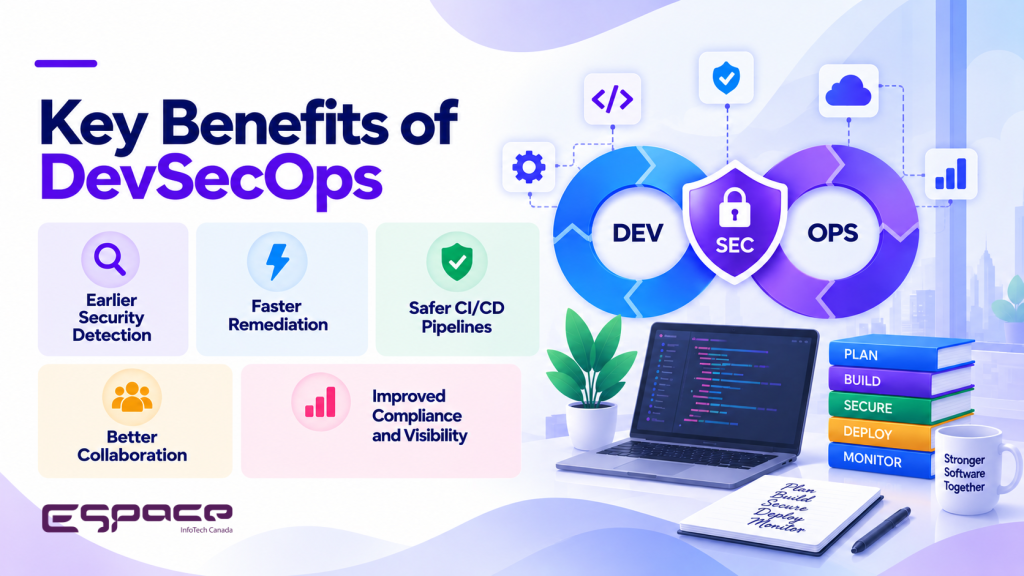
1. Earlier Security Detection
Automated security checks can identify vulnerabilities during development and testing.
Developers can address issues before they reach production.
2. Faster Remediation
When security findings appear close to the point where code was created, teams can often investigate and fix them more efficiently.
3. Safer CI/CD Pipelines
Security checks can be integrated directly into CI/CD pipelines.
Before code is deployed, automated processes can check dependencies, configurations, code, containers, and infrastructure for known risks.
4. Better Collaboration
DevSecOps encourages developers, operations teams, and security professionals to work together.
This creates shared responsibility instead of treating security as a separate final-stage activity.
5. Improved Compliance and Visibility
Security controls, logs, access policies, and automated checks can provide better visibility into how applications are developed and deployed.
This can make it easier for organizations to demonstrate that security practices are being followed.
How to Implement DevSecOps
Businesses do not need to transform their entire development process overnight. A practical implementation can start with a few important areas.
Start with Security Assessment
Review the existing development lifecycle and identify where security checks currently happen. Look for gaps in code security, dependencies, infrastructure, access control, secrets, and deployment.
Add Automated Security Testing
Security scanning can be integrated into development and CI/CD pipelines.
Depending on the application, teams may use:
Static application security testing
Dependency scanning
Container scanning
Infrastructure security checks
Dynamic application testing
Protect Secrets and Access
API keys, passwords, tokens, and credentials should not be stored directly in source code.
Use proper secrets management and apply least-privilege access wherever possible.
Monitor Production
Security does not end after deployment. Teams should monitor logs, unusual activity, access attempts, vulnerabilities, and infrastructure behaviour continuously.
AI Implementation in DevSecOps
AI is adding another layer of capability to modern security and DevOps workflows.
AI can help analyze large volumes of logs, identify unusual behaviour, prioritize security alerts, summarize incidents, and support vulnerability investigation.
For example, an AI-assisted security system can help identify patterns across application logs and highlight activity that may require human investigation.
AI can also help developers understand security findings and suggest possible remediation steps.
However, AI-generated recommendations should be reviewed before critical changes are made to production systems.
Human oversight, testing, access controls, and security policies remain essential.
DevSecOps Is Not Only for Large Enterprises
DevSecOps can benefit startups and growing businesses as well.
In fact, introducing security practices early can be easier than trying to redesign an established development process later.
For SaaS companies, fintech businesses, healthcare platforms, ecommerce companies, and other organizations handling sensitive data, security should be considered part of the product architecture from the beginning.
Conclusion
The question is no longer simply DevSecOps vs DevOps.
For modern software teams, security needs to become part of how DevOps works.
DevOps helps businesses build and release software faster. DevSecOps adds the security practices needed to make that faster delivery safer and more sustainable.
The strongest development teams do not treat security as a final checkpoint.
They build it into the process from the beginning.
Espace Infotech Canada Inc. can help businesses implement secure cloud development, DevOps automation, CI/CD pipelines, and DevSecOps practices designed for modern software products.